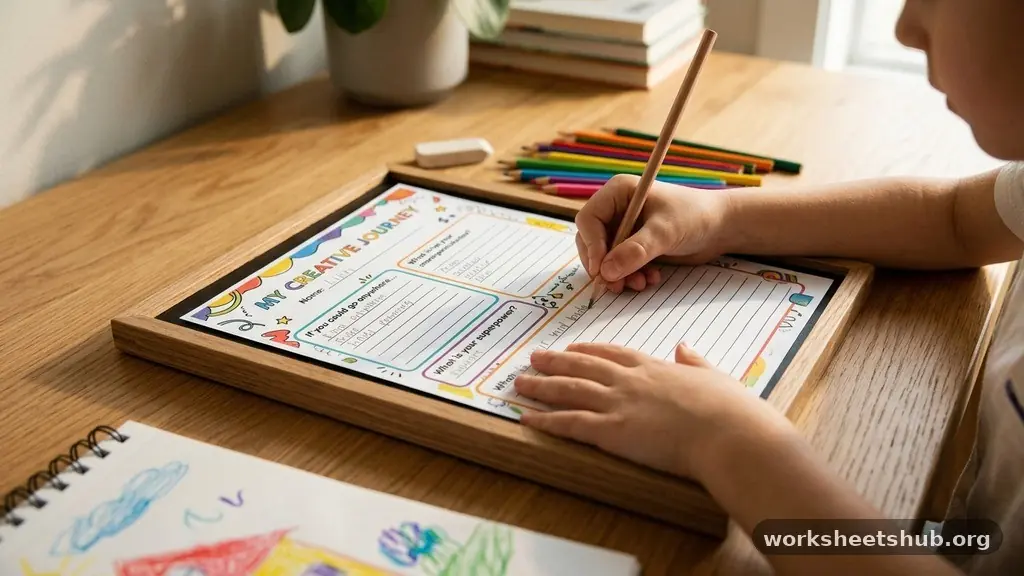
Utilizing creative writing prompts that help children express their ideas provides a powerful pathway for them to articulate their inner thoughts and unique perspectives. By removing the pressure of a blank page, these structured starting points allow young authors to focus on the joy of storytelling rather than the stress of finding a topic.
Whether they are exploring distant galaxies or describing their favorite backyard memories, children develop critical literacy skills through the act of drafting their own narratives. This approach builds writing confidence by proving that every child has a valid story to tell, provided they are given the right spark to ignite their imagination.
Understanding the Impact of Structured Prompts
Structured writing exercises act as a mental scaffolding for young learners, bridging the gap between a vague thought and a finished sentence. Many children feel intimidated by the sheer vastness of a blank piece of paper.
Providing a specific scenario or a “what if” question removes the fear of starting, allowing them to jump straight into descriptive language. When a child is asked to describe a dragon that only eats vegetables, they aren’t just writing; they are actively exercising their cognitive muscles.
Research consistently shows that regular engagement with writing exercises fosters better narrative development. By practicing the act of writing consistently, children learn how to organize their thoughts, which is a transferable skill for all academic subjects.
These prompts are not meant to stifle originality. Instead, they serve as a launchpad for imaginative play, where the child takes the initial idea and runs with it in their own direction.
Consistency is key to developing these habits. Setting aside just fifteen minutes a day for a quick writing exercise can yield significant improvements in a student’s ability to communicate complex concepts.
It transforms writing from a chore into an opportunity for creative expression. Over time, the child begins to internalize these structures, eventually needing fewer prompts to initiate their own original projects.
Building Emotional Intelligence Through Narrative
Writing is one of the most effective tools for processing complex feelings. When we provide creative writing prompts that help children express their ideas, we often find that they use characters to mirror their own emotional states.
A story about a nervous robot starting school is often a safe, indirect way for a child to talk about their own anxieties. This form of narrative therapy allows them to explore their feelings without the vulnerability of direct confrontation.
Perspective taking is another crucial benefit of this practice. When a child writes from the viewpoint of someone else—or even an object—they are training their brain to consider different emotional realities. Asking a student to write about a day in the life of a discarded toy encourages empathy.
They must imagine how that toy feels, what it sees, and what it misses. This deep dive into character building is fundamental to developing emotional maturity.
Teachers and parents can support this by offering prompts that specifically target social-emotional themes. Questions that ask “How would you help a friend who lost their favorite item?” or “What would you do if you were invisible for a day?” force the child to weigh ethical decisions and emotional outcomes.
These exercises are not just about grammar; they are about understanding the human experience. As children gain this insight, their writing becomes more nuanced and layered.
Developing Sensory Details and Descriptive Language
Great writing lives in the details, and teaching children to use their five senses is the fastest way to improve their work. Many beginning writers default to simple statements like “the dog was scary.”
A well-crafted prompt can push them to go much further. Asking them to describe a monster by its smell, the sound of its footsteps, or the texture of its fur forces them to use more evocative vocabulary.
This focus on sensory details makes the writing process more immersive for the child. It encourages them to slow down and observe the world around them with greater intent.
When they start looking for specific colors, sounds, and textures in their daily life, they build a mental library of descriptions they can use in their stories later. This habit transforms their writing from a flat summary into a vibrant, living scene.
To help children practice this, you can provide a list of “sensory starters” that focus on specific environments. For example, ask them to describe a kitchen while a meal is being cooked or a park during a thunderstorm.
By focusing on one sense at a time, they learn how to layer information without becoming overwhelmed. This systematic approach to building a scene is a cornerstone of effective literacy skills and long-term writing success.
Creating Fantasy Worlds and Logical Plots
Fantasy world-building is a favorite among children, providing a sandbox where they can experiment with rules and consequences. When a child creates a world where gravity works differently or animals can talk, they are inadvertently learning about plot structure and consistency.
They have to decide how their world functions and ensure that their story adheres to those internal rules. This high-level thinking is a significant step in their intellectual development.
Plotting a story requires a clear understanding of cause and effect. If the hero of their story finds a magic ring, what happens next? Does the ring grant wishes, or does it cause trouble?
These questions push children to think ahead and anticipate the outcomes of their character’s actions. This is the foundation of logical narrative construction, a skill that will serve them throughout their academic career.
It is helpful to provide prompts that encourage them to build their own rules. For instance, ask them to invent a planet where the color blue is forbidden or a city where everyone travels by jumping.
By establishing these constraints, you actually free them to be more creative. Constraints force the brain to find unconventional solutions, which is the heart of all great storytelling.
Comparison of Writing Prompt Types
Different children respond to different types of prompts. Some prefer structured, logical challenges, while others thrive on abstract, open-ended questions.
Understanding these differences can help you tailor your approach to get the best results. The following table illustrates the common types of prompts and the specific skills they reinforce.
| Prompt Category | Focus Area | Primary Skill Reinforced |
|---|---|---|
| Descriptive | Sensory input | Vocabulary and imagery |
| Problem-Solving | Logical outcomes | Plot structure |
| Perspective | Character empathy | Emotional intelligence |
| World-Building | Imaginative rules | Creative consistency |
Each of these categories serves a unique purpose in a child’s development. A well-rounded writing practice should include a mix of all four.
By rotating these styles throughout the week, you ensure that the child is constantly challenged in new ways. This variety keeps the writing process fresh and exciting, preventing the child from falling into a repetitive rut.
Essential Tools for Encouraging Daily Writing
To make creative writing a regular habit, you need to have the right tools on hand. Many children find that keeping a dedicated notebook makes the activity feel more official and important.
Allowing them to decorate their journal can also increase their sense of ownership over the project. When a child feels that the book belongs to them, they are much more likely to return to it consistently.
Journal prompts can be written on slips of paper and stored in a jar for easy access. Whenever a child is looking for inspiration, they can pull a random prompt from the jar.
This element of chance can be very appealing to younger students. It removes the pressure of choice and turns the writing session into a game.
Here are some effective ways to keep the momentum going:
- Use a “Prompt Jar” filled with written scenarios to remove the stress of deciding what to write.
- Allow for “free-write” sessions where the prompt is merely a suggestion that can be ignored.
- Encourage the use of illustrations to accompany the writing, which helps visual learners map out their ideas.
- Create a “story wall” where completed pieces can be displayed to celebrate their achievements.
- Provide a “word of the day” to challenge them to incorporate new vocabulary into their entries.
These simple strategies turn writing into a social and interactive experience. When children see their work acknowledged and valued, their motivation increases significantly.
Providing a supportive environment is just as important as the prompts themselves. Always focus on the effort and the spark of an idea rather than perfection in grammar or spelling.
Common Challenges and How to Overcome Them
It is natural for children to hit a wall or lose interest occasionally. Perfectionism is a common hurdle, where the child fears that their idea isn’t “good enough” to write down. When this happens, remind them that the first draft is just for them.
Encourage them to write without stopping to correct spelling or worry about sentence structure. The priority is to capture the idea before it disappears.
Another common issue is the “I don’t know what to write” response. Instead of letting them stop, offer a series of open-ended questions to help them narrow down their focus. Ask them about the weather in their story, or what their character had for breakfast.
These small, low-stakes questions often unlock the flow of ideas. Once they start writing about something simple, the rest of the story usually follows naturally.
If a child gets stuck on a plot point, suggest a “what if” twist. What if the character loses their map? What if the doorbell rings at that exact moment?
These external interruptions force the character to react, which naturally drives the plot forward. The goal is to keep the pen moving. By focusing on the process rather than the final product, you reduce anxiety and foster a love for the craft.
Frequently Asked Questions
How often should a child use these writing prompts?
Consistency is more important than duration. Aiming for three to four times a week for about fifteen to twenty minutes is ideal. This frequency keeps the habit alive without making it feel like a heavy school assignment.
Should I correct the grammar in their writing?
It depends on the goal of the session. If the focus is on creative expression, it is better to prioritize the flow of ideas over technical accuracy. You can save the grammar lessons for a different time so as not to discourage the child’s enthusiasm.
What if my child prefers drawing to writing?
That is perfectly fine and should be encouraged. Many children use drawing to plan their stories before writing, or they might write a caption for a complex illustration. Treat their art as a valid form of narrative development.
How do I know which prompts are appropriate for my child’s age?
Start with simple, relatable scenarios and gradually increase the complexity. If the child is struggling, the prompt is likely too abstract. If they finish in seconds, try a prompt that requires more world-building or character development.
Can these prompts be used in a group setting?
Absolutely, and they are often more fun that way. A group can brainstorm ideas together, or each child can write a different ending to the same prompt. This collaborative environment fosters a supportive writing community.
Nurturing the Next Generation of Storytellers
Creative writing prompts that help children express their ideas are far more than simple classroom exercises. They are the seeds of critical thinking, empathy, and lifelong communication skills.
By providing a safe space for young minds to explore their thoughts, we empower them to view the world with curiosity and confidence. Whether they are writing about dragons or their own daily experiences, the act of putting thoughts onto paper is a profound developmental milestone.
As you continue to use these tools, remember that the goal is always to foster a genuine love for storytelling. Praise the effort, celebrate the unique voice each child brings to their work, and keep the environment light and supportive.
By incorporating these creative writing prompts that help children express their ideas into your daily routine, you are giving them a gift that will last a lifetime. Encourage them to keep writing, keep dreaming, and most importantly, keep sharing their stories with the world.