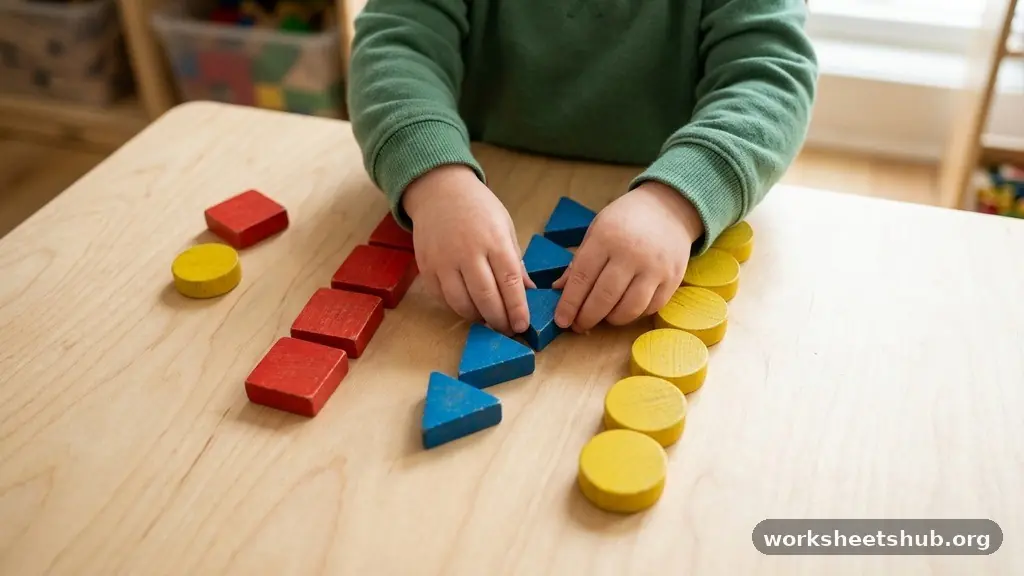
Understanding how classification activities strengthen critical thinking in kids provides parents and educators with a powerful, low-cost tool for cognitive growth. When children learn to group items based on shared traits, they are doing much more than just organizing toys or blocks. They are building the mental scaffolding required for complex problem-solving, data analysis, and scientific inquiry later in life.
This article examines the developmental benefits of sorting, the neurological processes involved, and practical ways to integrate these exercises into daily routines. By prioritizing these foundational logic tasks, adults can help children refine their ability to process information efficiently and make sense of the world around them.
The Cognitive Foundation of Sorting
At its core, classification is the process of identifying attributes and grouping objects according to those specific properties. When a child decides that a red plastic apple belongs with a wooden strawberry because both are “fruit,” they are performing an act of attribute identification. This process requires the brain to ignore irrelevant details—such as size or material—and focus on the defining characteristics that matter for the task.
This mental exercise is a cornerstone of cognitive development during the early childhood years. By constantly evaluating objects, children move from simple, concrete observations to more abstract conceptualizations.
For instance, a toddler might start by sorting by color, which is a visual, surface-level trait. As they mature, they begin to sort by function, origin, or even invisible properties like “living versus non-living.”
This progression is not automatic; it requires practice and intentional interaction with the environment. Every time a child engages in a sorting game, they are strengthening the neural pathways associated with logical reasoning.
They learn that the world has order and that they have the agency to impose that order themselves. This realization is vital for building confidence in their own intellectual abilities.
Developing Executive Function through Categorization
Executive function refers to the set of mental skills that include working memory, flexible thinking, and self-control. Classification activities are excellent for training these specific brain functions because they demand constant adjustment and focus. When a child is asked to sort a deck of mixed cards, they must hold the rules of the game in their mind while scanning the items.
If the rule changes mid-game—for example, switching from sorting by shape to sorting by edge smoothness—the child must exercise cognitive flexibility. They have to inhibit the urge to continue sorting by the previous rule and pivot to the new one. This is a direct workout for the prefrontal cortex, the area of the brain responsible for complex planning and decision-making.
Furthermore, these tasks improve working memory by requiring the child to remember which objects have already been placed in a category. If they misplace an item, they must analyze their error and correct it, which introduces the concept of self-monitoring. These are the same skills students use later when organizing a research paper or managing a complex project.
Pattern Recognition and Scientific Inquiry
The ability to spot patterns is the bedrock of all scientific discovery. When children engage in classification, they are essentially performing the same work as a biologist creating a taxonomy or a chemist identifying elements. They learn to look past the superficial appearance of an object to understand its underlying structure or purpose.
Consider a child sorting a collection of autumn leaves. They might group them by the number of points, the color intensity, or the texture of the veins.
By doing this, they are practicing critical analysis, questioning why certain items belong together and others do not. This leads to deeper inquiry about the natural world.
This type of early scientific training encourages children to ask “why” and “how” rather than simply accepting facts. When they notice that all the items in their “heavy” pile sink in a bucket of water, they are forming a hypothesis.
They are learning that classification is a predictive tool. This is how the scientific method begins to take root in a young, curious mind.
Practical Approaches to Sorting Games
You don’t need expensive materials to boost a child’s logic skills; the most effective tools are often found around the house. Sorting household items like cutlery, laundry, or toy cars provides a real-world context that makes the activity meaningful. The key is to increase the complexity as the child becomes more proficient.
* Binary Sorting: Start with two clear categories, such as “things that are blue” versus “things that are not blue.”
* Multi-Attribute Sorting: Introduce secondary characteristics, such as sorting by both color and size simultaneously.
* Hierarchical Organization: Create sub-categories, such as sorting animals into “mammals,” “reptiles,” and “birds,” then further dividing those into “land-dwelling” and “water-dwelling.”
* Venn Diagrams: Use overlapping circles to show how items can belong to two categories at once, such as “red things” and “round things.”
Using Venn diagrams is particularly effective for older children because it introduces the concept of intersectional logic. It forces them to consider that objects are rarely one-dimensional. This helps them understand nuance and complexity in their thinking processes.
Comparing Traditional and Digital Sorting
While digital games are popular, physical, tactile activities offer unique benefits for brain development. Handling physical objects engages the motor system, providing sensory feedback that reinforces the mental task. The following table highlights the differences between physical and digital classification methods.
| Feature | Physical Sorting | Digital Sorting |
|---|---|---|
| Sensory Input | High (touch, weight, texture) | Low (visual, haptic) |
| Creativity | High (open-ended rules) | Moderate (pre-programmed) |
| Spatial Awareness | High (physical manipulation) | Low (screen constraints) |
| Accessibility | Immediate | Requires device |
Physical sorting allows for problem-solving strategies that are not possible in a digital environment. For instance, a child might run out of space on their table and have to physically reorganize their piles to make room. This teaches spatial management and resource allocation in a way that an app cannot.
The Role of Language in Classification
Language and logic are deeply intertwined. As children sort objects, they are compelled to label them and explain their reasoning, which significantly enhances their vocabulary. When a parent asks, “Why did you put the spoon in this pile?” the child must articulate their thought process.
This verbalization turns a silent activity into a dialogue about deductive reasoning. The child learns to use descriptive adjectives and comparative language, such as “heavier,” “rougher,” or “more flexible.” These words are the building blocks of logical arguments.
By narrating their choices, children also learn to accept feedback and adjust their logic. If a parent points out that a plastic fork is not actually silverware but a utensil, the child learns to refine their categories. This iterative process is crucial for developing a precise and accurate way of thinking.
Building Resilience Through Logical Failure
Classification activities provide a safe space for children to make mistakes and learn from them. If a child incorrectly categorizes an item, the “error” is usually obvious and easy to correct. This low-stakes environment prevents the frustration that often accompanies more complex academic tasks.
When a child realizes they have made a mistake in their sorting, they are practicing self-correction. This is a vital component of executive function.
Instead of seeing failure as a negative outcome, they learn to view it as a piece of data. They adjust their sorting criteria and try again.
This builds intellectual resilience. Children who are comfortable with the trial-and-error nature of sorting are more likely to approach difficult subjects like math or coding with a positive attitude. They understand that logic is not about being right the first time; it is about refining one’s approach until the result is accurate.
Connecting Logic to Real-World Success
The ultimate goal of fostering these skills is to prepare children for the complex information landscape they will face as adults. In a world saturated with data, the ability to categorize information effectively is a competitive advantage. This is what many experts refer to as mathematical and logical literacy, which underpins success in almost every modern career field.
Whether they are reading news, managing a budget, or analyzing scientific data, adults rely on the same skills they practiced as children with blocks and buttons. They are constantly identifying patterns and sorting information into meaningful groups. Starting this process early ensures that these habits become second nature.
By making classification a part of their daily life, you are equipping children with the tools to organize their own thoughts. They become better at planning, better at communicating, and better at finding solutions to problems. These are not just academic skills; they are life skills that serve them well beyond the classroom.
Frequently Asked Questions
At what age should I start classification activities?
You can introduce basic sorting as soon as a child can grasp objects, typically around 12 to 18 months. Start with simple color or size differences using large, safe items like blocks or balls.
What if my child gets frustrated with sorting?
Frustration often indicates that the task is too complex for their current development level. Simplify the categories, provide fewer items, or join in to model the process and make it a collaborative game rather than a test.
How do I make sorting more challenging for older kids?
Introduce abstract categories like “things that are man-made versus natural” or “items that require electricity.” You can also limit the time they have to complete the sort to add a layer of speed and focus.
Can sorting help with reading or math?
Yes, absolutely. Sorting is a precursor to understanding sets in math and phonics in reading. Recognizing that letters have different sounds and shapes is essentially a complex form of classification.
Does the number of items matter in a sorting game?
It depends on the goal. For younger children, a smaller set of 5 to 10 items is usually best to keep them focused. For older children, a larger set can provide a better challenge for their memory and analytical skills.
Conclusion
Integrating these logic-based games into a child’s routine provides lasting cognitive benefits. By focusing on how classification activities strengthen critical thinking in kids, parents can turn mundane cleanup or playtime into an active learning session. These exercises do more than teach organization; they build the foundational logic, executive function, and pattern recognition skills that children need to succeed in every area of life.
Start small by incorporating simple sorting tasks into daily chores. As your child grows, introduce more abstract concepts and multiple attributes to keep their minds engaged and challenged. By making these activities a consistent part of their development, you are providing them with the tools to navigate a complex world with clarity, confidence, and a sharp, analytical mind.