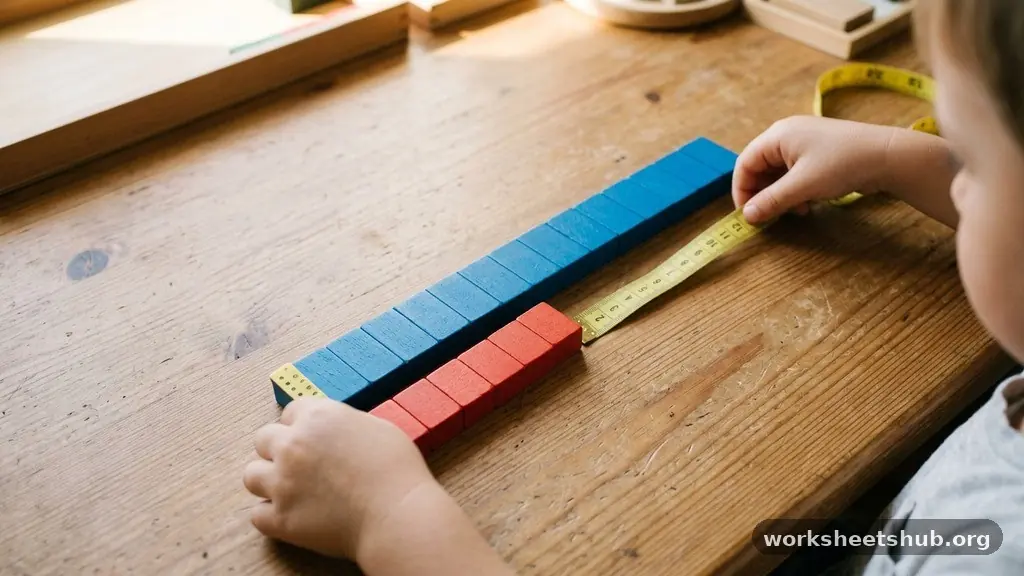
Learning how comparison activities teach bigger, smaller, longer, and shorter provides children with the vital tools necessary to interpret the physical world. By engaging in hands-on tasks, young learners move beyond abstract concepts and begin to internalize how objects relate to one another in space. This process forms the bedrock of mathematical thinking, as children transition from simple observations to complex measurement attributes.
Whether you are using building blocks, household items, or nature walks, these experiences build essential cognitive development. You will find that mastering these foundational skills helps children develop confidence in their ability to analyze, categorize, and quantify their surroundings with increasing accuracy and ease.
The Role of Sensory Exploration in Early Math
Sensory exploration serves as the primary gateway for children to understand the physical dimensions of their world. When a child touches a smooth, long ribbon or lifts a heavy, small rock, they are gathering raw data about volume, mass, and extension. This tactile engagement is far more effective than static pictures because it forces the brain to reconcile visual input with physical resistance.
These experiences allow children to practice direct comparison before they ever encounter a formal ruler or scale. By holding two items side-by-side, a child can immediately perceive which is larger or smaller without needing to know a numerical value. This form of learning establishes the importance of reference points in their developing mental models.
Teachers and parents can enhance this by providing varied materials that highlight specific attributes. For instance, comparing the thickness of two different books helps isolate the concept of width, while comparing the height of two towers focuses on vertical extent. This targeted approach ensures that children do not just guess, but actually observe the differences in the objects they handle.
Mastering Direct Comparison Techniques
Direct comparison is the act of placing two objects together to see which is greater or lesser in a specific dimension. This is the most fundamental step in how comparison activities teach bigger, smaller, longer, and shorter to young minds. When a child lines up two pencils to see which one is longer, they are performing a basic geometric operation.
Alignment is the secret to success in these early activities. If a child compares the length of two sticks but fails to line up the starting edges, their conclusion will be flawed. Encouraging them to “start at the same line” introduces the concept of a fixed origin, which is crucial for later work with number lines and graphs.
You can facilitate this by using simple tools like masking tape on a floor or a flat table edge. These boundaries provide the necessary support for children to align objects correctly. Once they master this physical alignment, they become much better at articulating why one object is longer or shorter than another.
Developing Spatial Reasoning Through Seriation
Seriation takes direct comparison a step further by requiring children to order three or more objects based on a specific attribute. This is a significant milestone in cognitive development because it requires the child to hold multiple relationships in their mind at once. They must understand that object A is smaller than B, but larger than C.
This activity is a classic way to teach relative size in a structured, logical sequence. You might ask a child to arrange a set of nesting dolls or a collection of sticks from shortest to longest. This task forces them to look beyond the immediate pair and consider the entire set as a cohesive group.
The challenge of seriation helps children refine their visual discrimination skills. They must look closely at subtle differences that might have been ignored during simple pair comparisons. This level of focus is exactly what builds the foundation for more advanced geometry and algebraic thinking later in their education.
Utilizing Non-Standard Measurement
Before children can understand inches or centimeters, they must grasp the logic behind measurement. This is where non-standard units become incredibly useful for early learning. Using paperclips, blocks, or even steps to measure a room helps children understand that measurement is simply counting the number of times a unit fits into a total length.
This approach prevents the common frustration of trying to understand abstract numbers without context. When a child says a table is “ten blocks long,” they are demonstrating a clear understanding of the relationship between the object and the unit of measure. It turns the process of length estimation into a tangible, achievable goal.
| Activity Type | Primary Learning Outcome | Tools Used |
|---|---|---|
| Direct Comparison | Visual discrimination | Blocks, pencils, ribbons |
| Seriation | Ordering and sequencing | Nesting toys, varying sticks |
| Non-Standard Units | Concept of measurement | Paperclips, crayons, hands |
| Height vs. Width | Attribute identification | Books, boxes, furniture |
Addressing Height Versus Width Confusion
One of the biggest hurdles in early geometry is distinguishing between different dimensions of the same object. A child might look at a wide, short box and a tall, thin box and struggle to define which is “bigger.” This highlights why it is vital to keep conversations focused on one attribute at a time.
You can help clarify this by using comparative language that is specific to the attribute being measured. Instead of asking “which is bigger,” ask “which is taller” or “which is wider.” This precision teaches the child that size is not a single, monolithic quality but a combination of several independent dimensions.
Exposing children to objects that challenge their assumptions is a great way to deepen their understanding. For example, show them a tall, thin vase and a short, wide bowl. Asking them to explain why the vase is taller but the bowl holds more helps them separate height from volume and total size.
Integrating Measurement into Daily Play
The most effective way to reinforce these concepts is to weave them into the natural rhythm of a child’s day. You don’t need a formal classroom setting to teach these lessons; the world is full of opportunities for comparison. During snack time, for instance, you can compare the lengths of carrot sticks or the sizes of different crackers.
Gardening is another fantastic environment for exploring these concepts. You can measure the growth of plants over several weeks, tracking which one is becoming the longest or tallest. This provides a long-term project that makes the abstract concept of growth feel very real and rewarding for the child.
Encouraging children to make predictions before they measure adds an element of scientific inquiry to their play. Ask them, “Do you think this book is longer than the tablet?” This simple question forces them to engage in length estimation before they verify the answer, which strengthens their intuitive sense of scale.
Common Hurdles in Learning Size Concepts
Even with the best intentions, children often run into specific roadblocks when learning about size and length. One common issue is “centering,” where a child focuses only on one end of an object while ignoring the other. This often leads to errors in judgment, such as thinking a crooked line is longer because it reaches further horizontally.
Another challenge is the tendency to equate size with mass. A child might assume that a heavy, small ball is “bigger” than a large, light balloon. You can address this by consistently separating the concepts of weight, volume, and length through specific, repeated examples that highlight one trait at a time.
Patience is the most important component when a child struggles with these ideas. These concepts are complex, and they require a significant amount of time to solidify in a developing brain. For more information on how children develop these skills, you can visit the National Council of Teachers of Mathematics to see how early childhood standards align with these activities.
Frequently Asked Questions
Why do children struggle to order objects by size?
Ordering objects requires the child to hold multiple relationships in their working memory simultaneously. They must compare the first object to the second, then the second to the third, while remembering the position of the first. This is a high-level cognitive task that takes practice to master.
Is it better to use standard or non-standard units?
For young children, non-standard units like blocks or hands are vastly superior because they are familiar and physical. Standard units like inches or centimeters are abstract and lack immediate meaning until the child has a firm grasp on the concept of measurement itself.
How can I teach these concepts without making it feel like school?
Keep the activities embedded in natural play. Use blocks during building, compare sizes of toys during cleanup, or talk about the lengths of shadows on a sunny day. When the conversation feels like a natural part of play, children are much more receptive to the concepts.
When should I introduce the language of comparison?
You can introduce comparative language as early as toddlerhood. Using words like “bigger,” “smaller,” “longer,” and “shorter” during everyday routines gives children the vocabulary they need to categorize their world. The earlier they hear these terms, the more naturally they will begin to use them in their own observations.
Why does height versus width confusion happen?
Children often view “size” as a single property. When they see an object that is tall but thin, they may struggle to reconcile its height with its overall bulk. Explicitly naming the dimension you are looking at helps them learn to isolate and analyze specific attributes.
Building a Foundation for Future Learning
Teaching children to identify and compare dimensions is a journey that starts with simple tactile play and evolves into a sophisticated understanding of geometry. By consistently using the right language and providing meaningful, hands-on tasks, you help them build a strong mental framework for all future mathematical thinking. Remember that every time a child compares two items, they are refining their ability to perceive the world with greater precision.
The beauty of how comparison activities teach bigger, smaller, longer, and shorter lies in their simplicity and accessibility. You do not need expensive materials or complex instructions to see real progress.
By staying observant and encouraging curiosity, you provide the best possible support for their cognitive growth. Start with small, everyday comparisons today and watch as their confidence in their own analytical skills grows alongside their understanding of the world around them.