Building a Simple Daily Learning Routine for Children is one of the most effective ways to foster academic curiosity and emotional stability in young learners. By establishing a predictable rhythm, you provide the security necessary for a child to move from passive observation to active engagement with new concepts.
This process is not about strict scheduling or high-pressure academic drilling; it is about creating a supportive environment where intellectual growth becomes a natural part of the day. You will find that when learning is integrated into daily habits, children develop better focus, confidence, and a genuine love for discovery that lasts far beyond their formative years.
Establishing the Foundational Rhythm
Consistency is the bedrock of any successful habit-forming process for kids. When a child knows exactly what to expect, their brain can move out of a state of anticipation and into a state of focus.
You don’t need a rigid, minute-by-minute schedule to achieve this. Instead, aim for a sequence of events that triggers the learning mindset, such as reading after lunch or exploring nature during a mid-morning break.
The goal is to align these activities with your child’s natural energy levels. Most children have a peak period of mental alertness shortly after a meal or after waking from a nap.
By anchoring your learning sessions to these high-energy windows, you maximize the efficiency of your time together. This approach respects their developing attention span while ensuring that key goals are met without causing frustration or burnout.
Utilizing Visual Schedules for Success
Visual schedules are powerful tools that translate abstract time into a concrete, manageable sequence. For younger children, a simple board with icons representing different blocks of time can make a world of difference. This helps them develop a sense of self-regulation because they can see the progression of their day without needing to constantly ask for updates.
When a child can physically check off a completed task, they experience a sense of accomplishment that reinforces the habit. This tangible feedback loop is particularly helpful for children who struggle with transitions or who feel overwhelmed by open-ended periods of time.
Start by keeping the schedule simple, perhaps limiting it to three or four main learning milestones. As they grow more comfortable, you can add more complexity or allow them to help design the flow of their day.
Integrating Play into Academic Goals
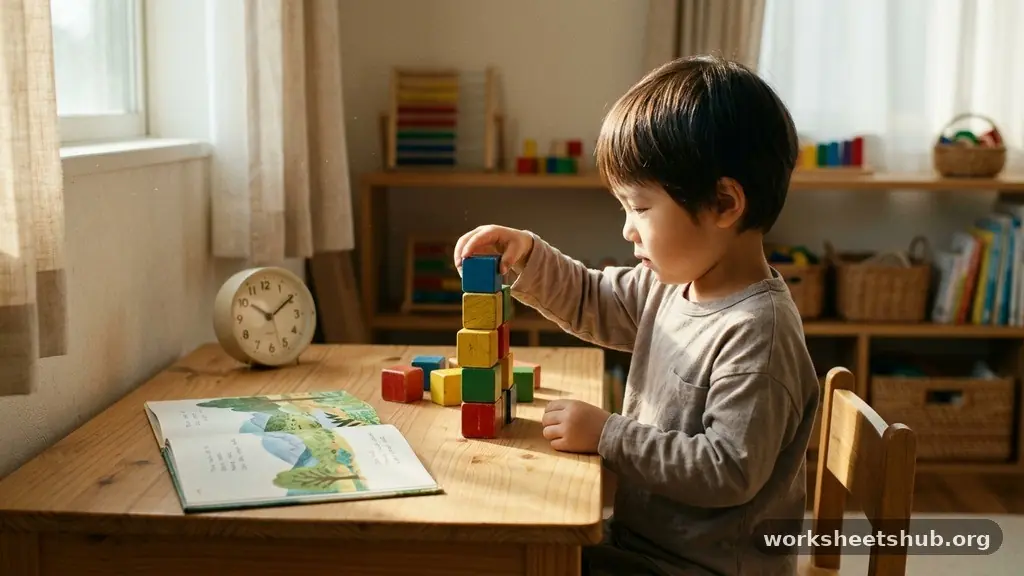
Educational play is perhaps the most effective vehicle for cognitive development in the early years. It allows children to experiment with complex ideas in a low-stakes environment, which is essential for building a growth mindset. When they are busy building a tower, they are learning about gravity and structural integrity; when they are sorting colored blocks, they are engaging in early mathematical reasoning.
You can enhance this by introducing inquiry-based learning techniques during these play sessions. Instead of providing all the answers, ask open-ended questions like “What do you think will happen if we add another block?” or “How could we stack these differently to make them stand up?” This subtle shift encourages them to think critically and helps them develop the confidence to test their own hypotheses.
Supporting Executive Function Through Routine
Executive function—the mental processes that enable us to plan, focus, and multitask—is still developing in children. A daily routine acts as a form of external scaffolding that supports these internal processes while they mature. By following a predictable sequence, children learn how to initiate tasks, sustain attention, and transition between different types of activities.
This doesn’t mean you should micromanage every minute of their day. Rather, it means providing the structure that allows them to practice these skills independently.
For example, if the routine is “clean up, then read,” they learn the importance of completing one phase before moving to the next. This sense of order reduces cognitive load and allows them to direct their mental energy toward the actual learning material.
The Role of Sensory Integration
Sensory integration is a vital component of how children process the world around them. A well-rounded routine should account for the different ways children receive and interpret information.
Some children learn best through physical movement, while others need quiet, tactile interaction to grasp a concept. You can structure your day to include a variety of sensory experiences, such as drawing, building, or even outdoor exploration.
If you find that your child is struggling to focus, look at the sensory environment. Are they getting enough physical activity to burn off excess energy?
Is the workspace too cluttered, or is there too much background noise? Adjusting the environment is often more effective than forcing a child to sit still for longer than their current capacity allows.
Methods for Effective Knowledge Retention
To ensure that what your child learns today stays with them, you can introduce simple versions of evidence-based learning strategies. Even young children benefit from the principles of active recall and spaced repetition.
Instead of just reading a book once, ask them to retell the story in their own words the next day. This forces their brain to retrieve the information, which strengthens the neural pathways associated with that memory.
You can also use a simple table to track progress on different subjects or skills. This helps you identify which areas need more attention and which ones they have already mastered.
| Learning Area | Activity Type | Frequency |
|---|---|---|
| Literacy | Read-aloud | Daily |
| Mathematics | Sorting/Counting | 3x Weekly |
| Science | Nature Observation | 2x Weekly |
| Art | Creative Expression | Daily |
Fostering Metacognition Early
Metacognition is essentially “thinking about thinking,” and it is a skill that can be cultivated from a surprisingly young age. By encouraging your child to reflect on their learning process, you help them understand their own strengths and preferences. You might ask, “What was the hardest part of that puzzle for you?” or “How did you figure out that piece belonged there?”
These small, reflective conversations turn learning into a collaborative journey rather than a top-down instruction. When children feel like active participants in their own education, their motivation naturally increases.
They begin to see themselves as capable learners who can navigate challenges, which is the hallmark of a healthy, resilient approach to education. You can find more resources on these developmental stages at the National Association for the Education of Young Children.
Addressing Common Challenges
It is natural for even the best-laid routines to hit snags occasionally. Some days, a child may be tired, frustrated, or simply uninterested in the plan you have created.
It is important to remember that flexibility is just as important as consistency. If a planned activity isn’t working, don’t be afraid to pivot to something else that captures their interest for that moment.
* Accept mood swings: Allow for “low energy” days where the curriculum is light.
* Rotate materials: Keep interest high by introducing new books or toys periodically.
* Follow their lead: If they show a deep interest in a topic, expand the routine to include it.
* Keep it short: It is better to have ten minutes of high-quality focus than an hour of struggle.
* Model the habit: Let your child see you reading or engaging in your own hobbies to show that learning is a lifelong pursuit.
Frequently Asked Questions
How long should a daily learning session last?
For children under the age of six, keep sessions short, typically ranging from 10 to 20 minutes. It is far better to have several short, engaging sessions throughout the day than one long, forced period that leads to burnout.
What if my child refuses to follow the schedule?
Refusal is often a sign that the child needs more autonomy or that the activity is not developmentally appropriate. Try giving them two choices for their next task, or allow them to lead the transition by setting a timer themselves.
Is it necessary to have a dedicated desk for learning?
No, a dedicated desk is not required. Many children learn effectively at the kitchen table, on the floor with a mat, or even outside in the grass. The physical space is less important than the psychological space you create through your routine.
How do I know if the routine is working?
Look for signs of increased engagement, curiosity, and a willingness to try new things. If your child begins to ask questions, initiates their own learning activities, or shows pride in their work, you are moving in the right direction.
Can I combine learning with chores?
Absolutely, and it is highly recommended. Sorting laundry is a math lesson, following a recipe is a literacy and science lesson, and organizing toys requires categorization skills. Integrating learning into the mundane tasks of daily life is the most natural way to build these habits.
Building Your Path Forward
Building a Simple Daily Learning Routine for Children is a journey that evolves as your child grows and develops. Start small by anchoring one or two activities to specific parts of your day, and gradually layer in more structure as you see what works best for your family. Remember that the ultimate goal is not to produce a perfect student, but to cultivate a curious, confident, and capable individual who enjoys the process of learning.
Stay patient with the process, celebrate the small victories along the way, and keep the environment warm and supportive. By prioritizing these positive habits now, you are laying a strong foundation for their future academic and personal success.