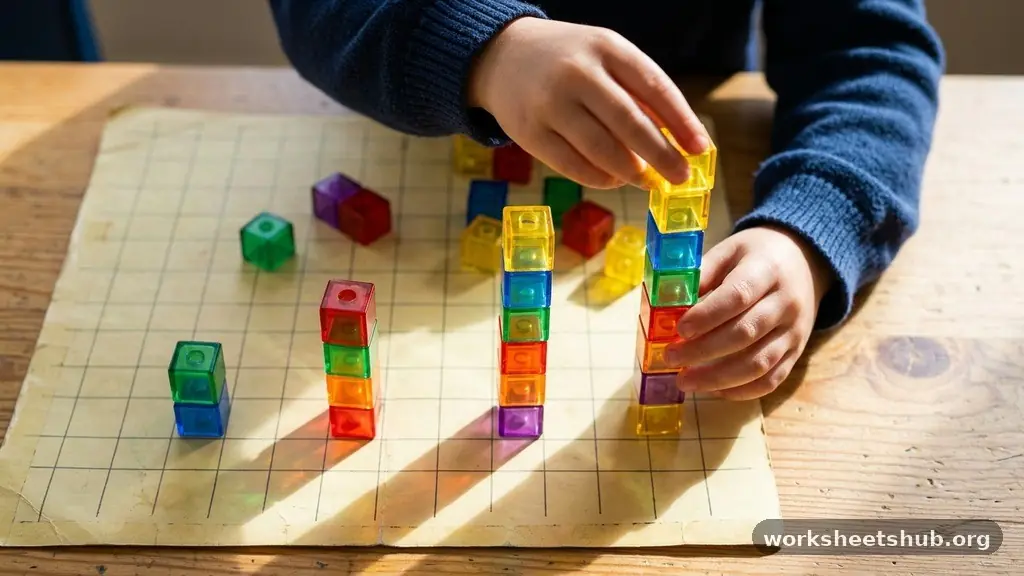
Engaging with fun number patterns that help kids think more logically transforms abstract arithmetic into a vibrant, interactive playground. By shifting the focus from rote memorization to the discovery of hidden structures, children begin to perceive mathematics as a living language of logic rather than a chore. This approach nurtures essential cognitive skills like pattern recognition and spatial reasoning, which are foundational for advanced problem-solving.
When young learners explore how numbers interact and repeat, they develop a deeper sense of curiosity and confidence. Understanding these sequences early on provides a massive advantage, ensuring that students view future challenges through a lens of inquiry rather than apprehension.
Which number patterns are most effective for building logic?
The most effective patterns are those that bridge the gap between simple counting and complex analysis. Starting with basic skip counting—adding the same number repeatedly—establishes the core concept of arithmetic progressions. Once a child masters this, they can move toward more sophisticated structures like the Fibonacci sequence.
These patterns provide immediate, visible results that encourage kids to predict what comes next. By using physical objects or visual grids, you turn dry theory into a tactile experience that sticks in their memory.
The Foundation of Skip Counting and Arithmetic Progressions
Skip counting serves as the gateway to understanding multiplication and algebraic thinking. When a child learns to count by twos, fives, or tens, they are essentially mapping out a linear path through the number line.
This repetition helps them see that numbers aren’t just isolated symbols but components of a larger, predictable system. It is the first step in recognizing how constant intervals create stability in mathematical expression.
To make this fun, use physical movement or rhythm. Have your child jump every time they hit a multiple of three or clap out a beat that corresponds to skip counting by fives.
These kinesthetic activities anchor the pattern in their bodies, making the abstract logic of arithmetic progressions feel concrete. You can even create a simple chart to track their progress, which serves as a visual reward for their growing mastery.
Visualising Growth with the Fibonacci Sequence
The Fibonacci sequence is perhaps the most famous example of a pattern that blends nature with mathematics. By adding the two previous numbers to get the next—1, 1, 2, 3, 5, 8, 13—children witness an exponential growth that feels almost magical.
You can show them this pattern by drawing squares on graph paper that grow according to these values. Seeing the resulting spiral appear on the page is a fantastic way to link mathematical logic to the biological world.
This sequence is an excellent tool for teaching kids to look for connections between seemingly unrelated things. When they notice the same numbers in the arrangement of sunflower seeds or the spirals of a pinecone, their appreciation for logic expands.
It moves them away from “doing math” and toward “observing the architecture of reality.” This shift is critical for developing the kind of abstract thinking needed for advanced geometry later on.
Unlocking Secrets within Pascal’s Triangle
Pascal’s Triangle is a treasure trove of hidden patterns that can keep a child occupied for hours. Each number is simply the sum of the two numbers directly above it, creating a symmetrical pyramid of values.
Within this structure, you can find the counting numbers, the triangular numbers, and even the powers of two. It is an ideal environment for kids to experiment with addition while discovering complex relationships.
You can encourage them to color-code the triangle based on odd and even numbers to reveal a fractal-like pattern. This visual exploration helps them see how simple rules can generate intricate, beautiful designs. It reinforces the idea that mathematical logic is not just about finding an answer, but about understanding the rules that govern how those answers are formed.
| Pattern Name | Rule of Growth | Primary Benefit |
|---|---|---|
| Arithmetic Progression | Add a constant value | Mastering multiplication |
| Fibonacci Sequence | Sum of previous two | Understanding growth |
| Geometric Sequence | Multiply by a constant | Identifying proportions |
| Prime Numbers | Only divisible by 1 and self | Developing critical analysis |
Building Logic through Number Bonds
Number bonds are essential for mental math because they teach children the relationship between parts and a whole. If a child understands that 7 and 3 make 10, they can quickly derive that 10 minus 7 is 3.
This flexibility is the bedrock of algebraic thinking. Rather than relying on rigid algorithms, they learn to break down numbers into manageable pieces.
You can turn this into a game by using playing cards or dominoes to find matching pairs that sum to a specific target. This practice improves their speed and accuracy, but more importantly, it builds a sense of intuition about how numbers behave. When they stop seeing a problem as a single entity and start seeing it as a collection of parts, their logic becomes significantly more agile.
The Role of Pattern Recognition in Sudoku
Sudoku puzzles are excellent for developing spatial reasoning and deductive logic. Because each row, column, and block must contain the digits one through nine without repetition, the player must constantly weigh possibilities.
This process forces a child to evaluate evidence and eliminate options based on the rules they have already established. It is a pure, distilled form of logical exercise.
Start with smaller, four-by-four grids to keep the frustration level low while they learn the mechanics. As they get comfortable, introduce larger grids that require more complex planning.
The beauty of this game is that it does not require advanced calculation, just a systematic approach to observation. It teaches them that patience and methodical checking lead to the correct solution.
Exploring Geometric Sequences
Geometric sequences, where each number is found by multiplying by a constant, introduce kids to the concept of rapid change. Unlike arithmetic progressions that grow steadily, geometric sequences can explode in value very quickly. This is a great way to talk about doubling or tripling, which are concepts that appear frequently in real-world scenarios like interest or population growth.
Try using a piece of paper to demonstrate this by folding it in half repeatedly. Ask the child to predict how many layers will exist after four, five, or six folds.
The physical reality of the paper getting thicker and harder to fold provides a great sensory experience that matches the mathematical logic. This concrete example helps them grasp how exponents work before they even reach a formal classroom setting.
The Mystery of Prime Numbers
Prime numbers are the “atoms” of mathematics, and their distribution is a fascinating puzzle for young minds. Because these numbers cannot be divided by anything other than one and themselves, they stand out against the more predictable composite numbers.
Identifying primes on a 100-square grid is a classic activity that never loses its appeal. It feels like a detective hunt where you are searching for the numbers that refuse to break down.
This exercise encourages children to test hypotheses and look for common divisors. It is a fantastic way to develop persistence and systematic testing in their problem-solving routine.
By learning about primes, children gain a deeper respect for the complexity hidden within the simplest of digits. For more in-depth resources on these concepts, the NRICH project offers excellent activities for developing mathematical habits.
Common Questions About Logical Number Play
How early can children start exploring number patterns?
Children can begin identifying basic patterns as early as preschool. Simple tasks like sorting colored blocks or identifying the next item in a repeating visual sequence are the first steps toward mathematical logic.
Do these patterns help with school math performance?
Yes, because these activities focus on the “why” behind the math. When a student understands the underlying structure of numbers, they find it much easier to pick up new topics like fractions or algebra later on.
What if my child finds a pattern frustrating?
Always pivot back to the simplest version of the task. If a specific sequence is too difficult, reduce the numbers involved or use physical manipulatives to make the logic visible. Keep the tone light and celebrate the process of searching rather than the speed of solving.
Should I focus on one pattern at a time?
It is often better to rotate between different types of patterns to keep interest high. Mixing a logic puzzle like Sudoku with a creative activity like drawing a Fibonacci spiral keeps the brain engaged in different ways.
Are these activities meant to be done alone?
While they can be done solo, discussing the patterns together is where the real learning happens. Ask your child to explain how they found the next number in the sequence to help them articulate their logical process.
Encouraging Logical Growth
Integrating fun number patterns that help kids think more logically is one of the most rewarding ways to support their academic and personal development. By turning math into a series of discoveries rather than a list of rules, you empower your child to approach the world with a curious and analytical mind. Whether they are exploring the symmetry of Pascal’s Triangle or hunting for prime numbers, these exercises build the mental muscles necessary for success in any field.
Remember that the goal is not to produce a math prodigy, but to foster a lifelong love of problem-solving. Stay patient, keep the activities playful, and listen to the creative ways your child interprets these sequences.
As they grow more comfortable with these patterns, you will see their confidence soar, not just in mathematics, but in their ability to approach any challenge with clear, logical thought. Continue to look for these hidden structures in daily life and share those “aha” moments together.