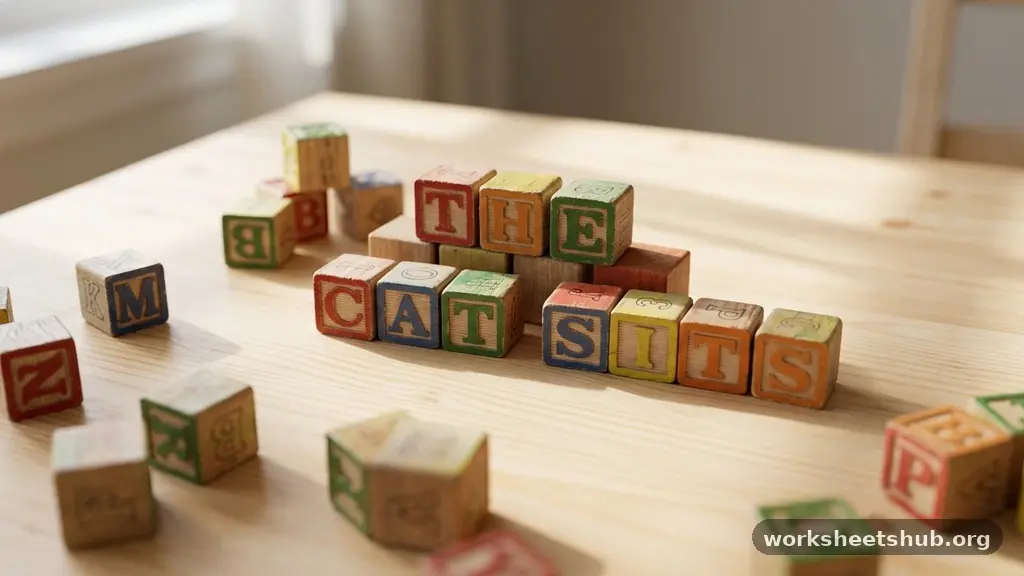
Incorporating simple Grammar Activities to Help Kids Understand Sentences can transform a daunting academic task into a joyful exploration of language. By shifting the focus from dry textbooks to interactive play, children develop a deeper intuition for how words connect to form coherent thoughts. These methods prioritize literacy development by grounding abstract rules in physical, hands-on learning experiences.
When children see sentences as structures they can build and manipulate, their confidence in both reading and writing grows significantly. This approach fosters a lasting appreciation for the mechanics of communication, setting a strong foundation for their future academic success.
Building Blocks of Sentence Structure
At the core of language lies the ability to recognize that every complete thought requires a subject and a predicate. You can demonstrate this using simple physical objects like wooden blocks or index cards. Write the subject of a sentence on one card and the predicate on another.
Encourage your child to swap these components to see how the meaning changes or becomes nonsensical. This tactile exercise makes the concept of subject-predicate agreement concrete rather than theoretical.
When children physically move these building blocks, they begin to grasp the necessity of word order. You might start with a simple sentence like “The dog runs.” Ask them to move “runs” to the front to see if the sentence still makes sense.
This helps them identify the specific roles words play within a structure. It is a foundational step in mastering syntax awareness without needing to memorize complex terminology.
The Power of Sentence Expansion
Once children understand the basic framework, you can introduce the concept of adding descriptive detail. Start with a bare-bones sentence, such as “The bird sings.” Challenge your child to add one word at a time to make the image more vivid.
They might change it to “The blue bird sings” and eventually “The small blue bird sings loudly.” This activity shows how adjectives and adverbs function to refine a message.
This game works exceptionally well because it rewards creativity while reinforcing grammatical boundaries. You are essentially teaching them how to build independent clauses that carry weight and interest.
It prevents the common pitfall of writing repetitive, flat sentences. By the time they reach middle school, this practice will have naturally ingrained a sense of rhythm and flow in their own writing.
Correcting Sentence Fragments
One of the most common hurdles in early writing is the tendency to write sentence fragments. You can address this through a game called “The Missing Piece.” Write several incomplete thoughts on slips of paper, such as “Running through the park” or “Because it was raining.”
Ask your child to identify what is missing to make these thoughts complete. They will soon realize that these phrases lack a clear subject or a finished action.
This activity is much more effective than simply marking a red “X” on a page. It turns sentence fragment correction into a puzzle-solving mission.
You can provide a “bank” of subjects and predicates they can use to “fix” the fragments. This builds their understanding of writing mechanics in a way that feels supportive and collaborative rather than punitive.
Visualizing Punctuation Through Movement
Punctuation marks are often treated as abstract symbols, but they can be taught as signals for the reader. Create a set of cards featuring a period, a question mark, and an exclamation point.
Read aloud a series of sentences with varying tones and ask your child to jump or clap whenever they hear a specific type of sentence. For example, they might jump on a command and clap on a question.
This kinesthetic approach helps children associate punctuation with the natural cadence of speech. It clarifies why we use a period to stop a thought and a question mark to signal curiosity.
You can find more resources on these fundamental language concepts at the Reading Rockets website. By linking punctuation to physical movement, you ensure the rules stick in their long-term memory.
Sorting Parts of Speech
Understanding how different parts of speech function is essential for long-term syntax awareness. Create a sorting activity where you provide a list of words and ask your child to place them into categories like “Action Words,” “Naming Words,” and “Describing Words.”
You can make this more engaging by using a muffin tin and labeled slips of paper. As they drop a word like “jump” into the “Action Words” section, they are reinforcing their knowledge of verbs.
This activity helps children see that words are not just random sounds but tools with specific jobs. Once they categorize the words, ask them to pull one from each tin to form a new sentence.
This encourages them to experiment with combinations they might not have considered before. It is a low-pressure way to build a robust vocabulary and a stronger grasp of how sentences are manufactured.
Coordinating Conjunctions in Practice
Conjunctions like “and,” “but,” and “or” are the glue that holds complex ideas together. A great way to teach this is through a “Sentence Bridge” activity.
Write two simple, independent sentences on two separate pieces of paper. Give your child a strip of paper with a conjunction written on it and ask them to “bridge” the two sentences together.
This helps them see how two separate thoughts become one cohesive compound sentence. You can challenge them to see how the meaning changes when they swap “and” for “but.”
This highlights the importance of logic in their writing. It is a sophisticated skill that, when introduced through simple play, becomes entirely manageable for a young learner.
Comparing Sentence Styles
Different types of sentences serve different purposes, and children benefit from seeing these side-by-side. Use a table to help them categorize the purpose of various sentences.
This visual aid clarifies why we choose certain structures over others in different contexts. You can fill this out together as you read a favorite book.
| Sentence Type | Purpose | Example |
|---|---|---|
| Declarative | Sharing information | The cat is sleeping. |
| Interrogative | Asking a question | Is the cat sleeping? |
| Imperative | Giving a command | Please wake the cat. |
| Exclamatory | Showing strong emotion | The cat is awake! |
This table serves as a handy reference guide when they are doing their own creative writing exercises. It empowers them to choose the right “tool” for the point they want to make.
Instead of just writing a list of facts, they learn to vary their syntax for better impact. It transforms writing from a chore into a deliberate, artistic process.
Gamifying Capitalization Rules
Capitalization rules often feel arbitrary to children until they are linked to the concept of respect and clarity. Create a “Detective Game” where you provide a paragraph that has intentionally stripped away all capital letters.
Give your child a green marker to act as the “Capitalization Detective” who finds the start of every sentence and the proper nouns. This turns proofreading into a game of hide-and-seek.
You can also include names of places or people to show that these words deserve special attention. When they find a mistake, ask them to explain why that word needs a capital letter.
This forces them to vocalize the rule, which is a powerful way to cement the knowledge. It makes the act of editing feel like a badge of honor rather than a correction of their work.
FAQ
How often should I practice these activities?
Consistency is more important than duration. Aim for short, ten-minute sessions three or four times a week to keep the momentum going without causing fatigue.
What if my child finds these activities frustrating?
If a child struggles, scale back the complexity. Focus on just one part of speech or a single sentence type until they feel confident before moving on to more intricate exercises.
Are these methods suitable for all age groups?
Yes, you can adapt these exercises for different levels. For older children, use more complex vocabulary and longer independent clauses to maintain the challenge.
Can I use these activities in a classroom setting?
Absolutely, these are designed to be flexible. They work just as well for small groups of students as they do for one-on-one sessions at home.
Where can I find more creative writing exercises?
Many educational websites offer printable prompts and games. Focus on resources that emphasize play and exploration over rote memorization.
Final Thoughts on Language Growth
Developing a strong command of grammar is a journey that flourishes when children feel encouraged to experiment. By using simple Grammar Activities to Help Kids Understand Sentences, you remove the fear of making mistakes and replace it with a curiosity about how language functions. Each activity mentioned here provides a unique perspective on the mechanics of writing, from the basic subject-predicate relationship to the nuanced use of conjunctions.
As your child gains these tools, they move from merely arranging words to crafting their own unique voice. Keep the sessions light, celebrate their creative discoveries, and enjoy the process of watching their communication skills evolve. Your consistent support is the most effective tool they have for mastering the art of the sentence.