Finding effective beginner-friendly addition practice ideas for early learners is a rewarding task that builds a lifelong foundation for mathematical confidence. By using hands-on tools and playful routines, children move beyond simple rote memorization to truly understand how numbers interact. This approach focuses on developing number sense through tangible experiences rather than abstract worksheets alone.
Whether you are a teacher setting up a classroom or a parent supporting a child at home, these strategies help turn daily interactions into meaningful learning moments. You will discover how to integrate movement, play, and visual aids to make addition an accessible and enjoyable part of a child’s daily routine.
Using Math Manipulatives for Conceptual Clarity
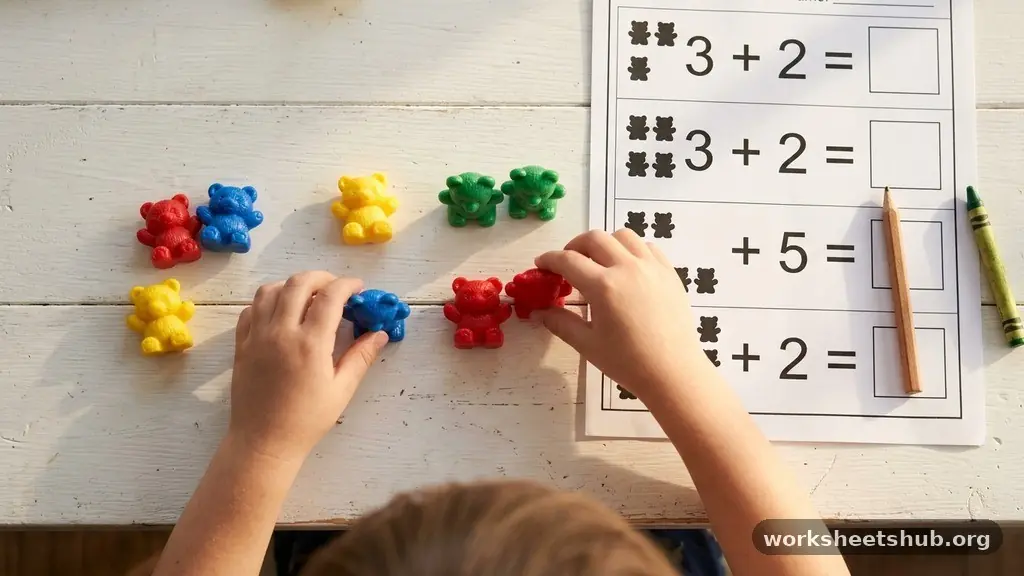
Math manipulatives are essential for helping children move from the concrete to the abstract. When a child can physically touch and move objects, they begin to see the logic behind an addition equation. You might use common household items like buttons, plastic bears, or dried beans to represent individual quantities.
By placing three items in one group and two in another, the child can physically combine them to count the total. This tactile engagement is far more effective for early learners than staring at a printed page of numbers.
The transition from physical objects to mental math requires a bridge often called the concrete-pictorial-abstract approach. Once a child is comfortable with physical objects, you can encourage them to draw pictures of those objects on paper. Eventually, they will replace the drawings with numerals.
This progression ensures the child understands that the number “5” represents a quantity of five items. Without this grounding, children often struggle to grasp what addition actually means in the real world.
Developing Number Sense with Ten Frames
A ten frame is a simple tool consisting of a two-by-five grid that helps children visualize quantities in relation to the number ten. This is one of the most powerful beginner-friendly addition practice ideas for early learners because it builds a strong sense of cardinality.
When a child fills a ten frame with seven counters, they can immediately see that they need three more to make a full set. This visual representation turns abstract addition into a spatial puzzle that is easy to solve.
You can use ten frames to teach the concept of “making ten,” which is a fundamental skill for higher-level math. By using two different colors of counters, you can show how different combinations, such as six and four or eight and two, always result in ten.
This method helps children internalize number bonds without the need for stressful drills. Once a child has mastered ten frames, they are much better prepared for more complex addition problems later on.
Mastering the Counting On Strategy
The counting on strategy is a vital milestone in a child’s mathematical journey. Instead of counting from one every time they add two numbers, a child learns to start with the larger number and count upward from there. For example, when adding three to five, the child says “five” and then counts “six, seven, eight.”
This saves time and encourages mental efficiency. It also demonstrates that the child understands the sequence of numbers and the concept of relative value.
You can practice this by using a number line taped to the floor or drawn on a chalkboard. Have the child stand on the first number and physically jump forward the number of spaces indicated by the second addend. This adds a physical component to the mental process, reinforcing the learning through movement.
As they become more proficient, you can transition to a smaller, handheld number line. Consistent use of this tool eventually leads to the child performing the jumps mentally.
Building Fluency Through Math Games
Math games provide a low-pressure environment where children can practice addition without the fear of getting an answer wrong. Card games are particularly effective for this purpose, as they are portable and easy to customize.
For example, a simple game involves drawing two cards from a deck and adding the values together to see who has the higher sum. This reinforces the idea that addition is a functional tool used to compare quantities.
Board games that involve dice also offer excellent opportunities for informal practice. When a child rolls two dice and adds the dots together, they are practicing subitizing—the ability to recognize a small group of objects without counting them individually. This skill is critical for developing math fluency.
You can find more structured ideas for these activities through the National Council of Teachers of Mathematics, which provides resources on fostering early numeracy. Incorporating these games into your daily routine ensures that addition practice feels like play rather than work.
Understanding Part-Part-Whole Relationships
The part-part-whole model is a conceptual framework that helps children understand how numbers are composed of smaller units. By using a simple diagram with two smaller circles connected to one larger circle, children can visualize how two parts join to create a total.
For instance, if you have a group of five red blocks and two blue blocks, the parts are five and two, and the whole is seven. This method is incredibly versatile and can be used with various physical objects.
This model is particularly helpful for teaching inverse operations, such as subtraction. If a child knows the whole is seven and one part is five, they can easily figure out that the missing part must be two. This builds a deeper understanding of the relationship between numbers than simple addition tables ever could.
Teachers often use this in math centers to allow children to explore these relationships independently. It encourages curiosity and allows children to experiment with different combinations of numbers.
Using Base Ten Blocks for Larger Sums
As children begin to move beyond simple sums, base ten blocks become an essential addition to their learning materials. These blocks help children understand place value, which is necessary for adding numbers that result in a sum greater than ten.
By using single units, rods of ten, and flats of one hundred, children see that ten units are equivalent to one rod. This visualizes the concept of “carrying” or regrouping in a way that makes logical sense.
Start by having the child represent a number like thirteen as one rod and three units. When they add another unit, they can physically see the total become fourteen. This prevents the common mistake of treating digits as independent symbols rather than representatives of value.
Base ten blocks provide a tactile way to explore the base-ten system that our entire number structure relies upon. They are a staple in most effective math curricula for good reason.
Organizing Effective Math Centers
Math centers allow children to rotate through different activities that reinforce specific skills in a self-directed way. A well-designed center for addition might include a station for dice games, a station for using base ten blocks, and a station for drawing equations.
By keeping these activities distinct, you provide variety that keeps the learning process fresh and engaging. It also gives you the opportunity to observe which strategies a child is struggling with and which they have mastered.
When setting up these centers, consider the following elements to maximize engagement:
- Clear instructions using simple, visual icons for non-readers.
- A variety of materials that cater to different sensory preferences.
- Consistent rotation schedules to keep interest levels high.
- Recording sheets that allow children to document their findings.
- Defined boundaries to keep materials organized and accessible.
These structures help minimize downtime and maximize the time spent on active learning. When children know exactly what is expected of them at each station, they are more likely to stay focused and productive.
Comparing Different Practice Methods
Different children respond to different types of stimulation, so it is helpful to offer a variety of ways to practice. The table below compares the primary benefits of various approaches to help you decide which to emphasize in your own environment.
| Practice Method | Primary Benefit | Best For |
|---|---|---|
| Math Manipulatives | Tactile reinforcement | Initial conceptual understanding |
| Ten Frames | Visualizing number bonds | Developing mental math skills |
| Number Line | Sequence awareness | Counting on strategy |
| Math Games | Engagement and fluency | Long-term retention and speed |
By rotating through these methods, you ensure that no single strategy becomes monotonous. This variety also allows you to identify if a child is a visual, auditory, or kinesthetic learner. Tailoring your approach based on these observations will lead to significantly better results.
Frequently Asked Questions
How early can children start practicing addition?
Children can begin exploring the concept of addition as soon as they understand the idea of “more” or “adding to.” Most children are ready for basic informal addition activities by the age of four or five, especially when these activities are play-based.
Are flashcards effective for early learners?
Flashcards are generally not recommended for early learners because they focus on rote memorization rather than conceptual understanding. It is much more effective to use physical objects or visual aids that allow the child to “see” the math in action.
What should I do if a child gets frustrated?
Frustration usually happens when the task is too abstract or exceeds the child’s current level of understanding. If this occurs, step back and simplify the problem by using more physical manipulatives or returning to smaller numbers until their confidence is restored.
How do I know if a child is ready for larger numbers?
A child is ready to move to larger numbers when they can consistently solve addition problems up to ten using mental strategies or quick counting. If they still rely heavily on counting every single item one by one, they may need more practice with smaller sums first.
Can these activities be done at home?
Absolutely, these activities are perfect for home environments because they use common items. You don’t need expensive equipment to teach addition; simple household objects like coins, toys, or even pieces of fruit work perfectly for these exercises.
Conclusion
Developing a strong foundation in math is about more than just getting the right answer; it is about building the mental tools to understand how our world is quantified. By using these beginner-friendly addition practice ideas for early learners, you provide children with the confidence to explore numbers without fear. Whether you are using tactile manipulatives, practicing with ten frames, or playing simple games, your goal is to make the process feel like a natural part of their day.
Consistency is the most important factor in long-term success, so try to integrate these short, fun activities into your daily routine whenever possible. As you observe their progress, you will notice their growing ability to manipulate numbers with ease and joy. Keep the experience light, celebrate every breakthrough, and enjoy the process of watching their mathematical thinking blossom.