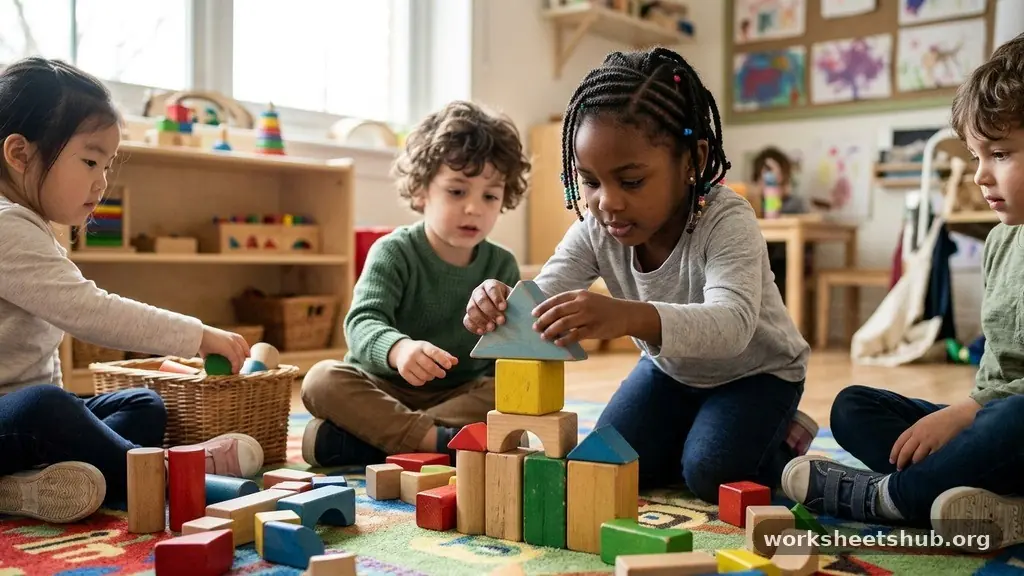
Finding creative ways to teach children about shapes and space is one of the most rewarding parts of early childhood education because it turns abstract math into a tangible adventure. By moving beyond worksheets and focusing on how objects occupy the world around them, you can help children develop a deep, intuitive understanding of geometry.
Whether you are using household items to demonstrate volume or building complex structures in the living room, the goal is to make spatial reasoning a natural part of daily life. This article provides practical, hands-on strategies that transform how kids perceive the physical environment, ensuring they master foundational concepts while having fun.
Building a Foundation with Tactile Learning
Tactile learning is the most effective way to help children internalize the difference between 2D shapes and 3D forms. When a child touches a physical object, their brain encodes information about edges, faces, and curves more effectively than if they were simply looking at a drawing on a screen.
Start by using common household objects to categorize items based on their geometric properties. A ball is a sphere, a cereal box is a rectangular prism, and a party hat is a cone.
You can enhance this experience by creating a “geometry scavenger hunt” in your home or classroom. Ask the child to find items that match specific descriptions, such as something with a flat circular face or an object that can roll in a straight line.
This encourages them to look at their environment through a mathematical lens. By physically handling these items, children begin to understand the concept of a vertex or a face without needing to memorize complex definitions.
This hands-on approach builds essential spatial awareness that serves as a precursor to more advanced mathematical thinking. When they feel the difference between the sharp corner of a block and the smooth curve of a marble, they are learning about the physical reality of geometry.
You can document these findings in a simple journal or on a chart, allowing them to track how many items they have identified in each category. This turns a simple game into a structured lesson on classification and observation.
Exploring Spatial Reasoning Through Block Play
Block play is arguably the most powerful tool for developing spatial visualization in young learners. When a child balances a heavy block on top of a smaller one, they are intuitively calculating gravity, symmetry, and structural integrity.
This is not just play; it is an early form of engineering that requires them to visualize how different pieces fit together to form a stable structure. Encourage them to build bridges, towers, and tunnels to test the limits of their designs.
To take this to the next level, introduce challenges that require specific spatial planning. Ask them to build a structure that is exactly as tall as their favorite stuffed animal or a bridge that can span the distance between two chairs.
These constraints force the child to think about scale, length, and width in a practical way. They must decide which blocks are best suited for the base and which should be used for the roof, teaching them about structural load and balance.
You can also use photographs to guide their construction projects. Show them a picture of a famous building or a simple geometric design and ask them to replicate it using their blocks.
This exercise improves their ability to translate a 2D image into a 3D form, a critical skill for understanding geometric nets later in their education. By providing these types of prompts, you guide their play toward intentional learning without stifling their natural creativity.
The Role of Pattern Blocks and Tangrams
Pattern blocks and tangrams offer a unique way to explore the relationship between different polygons. These tools allow children to see how smaller shapes can be combined to create larger, more complex ones.
For example, two trapezoids can form a hexagon, or two triangles can form a square. This is the foundation of understanding symmetry and area, as children realize that the total space remains consistent even when the arrangement changes.
Tangrams are particularly useful for teaching spatial rotation and flipping. Because tangram pieces must be moved and turned to fit a specific silhouette, children learn how to visualize shapes in different orientations.
This is a vital component of spatial reasoning that helps with later tasks like reading maps or understanding complex diagrams. You can find printable templates online to create your own sets if you do not have wooden or plastic pieces on hand.
Encourage children to create their own “tessellation” patterns using these shapes. A tessellation is a pattern of shapes that fit together perfectly without leaving any gaps or overlapping.
This helps them understand how shapes can tile a surface, which is a fundamental concept in both geometry and art. If you want to see how these concepts are applied in formal curriculum standards, you can check the National Council of Teachers of Mathematics website for age-appropriate resources.
Understanding Perimeter and Area with Everyday Tasks
Explaining perimeter and area can be difficult if you only use abstract math problems. Instead, use your home environment to demonstrate these concepts in a way that feels relevant to the child’s life.
Measuring the perimeter of a rug or the area of a tabletop helps them see that these numbers represent actual physical space. Use a piece of string to trace the edge of an object, then lay the string against a ruler to measure the total length.
For area, use grid paper or sticky notes to cover a flat surface. Ask the child to count how many squares it takes to cover a book cover or a placemat.
This provides a visual and physical representation of what “area” actually means. It moves the concept away from a multiplication formula and toward a concrete understanding of surface coverage.
This is also a great time to introduce the concept of “symmetry.” Fold a piece of paper in half and cut out a shape, then unfold it to show how both sides match perfectly.
You can do this with leaves, butterflies, or simple geometric cutouts. By emphasizing that symmetry means one side is a reflection of the other, you help them understand balance and aesthetic harmony in geometry.
Using Technology and Digital Tools
While tactile learning is primary, digital tools can offer a new perspective on shapes and space. Many educational apps allow children to manipulate 3D objects in a virtual space, rotating them to see all sides.
This can be especially helpful for visualizing complex forms that are difficult to build with physical blocks. These digital environments allow for experimentation without the frustration of blocks falling over, which can be encouraging for some learners.
However, keep screen time balanced with physical play. Use digital tools as a supplement to, not a replacement for, real-world exploration.
For instance, after building a structure with blocks, you might use an app to view a digital model of a similar structure. This helps them bridge the gap between the physical and the virtual.
Always look for apps that focus on open-ended creation rather than simple quiz-style games. The best digital tools for this subject are those that act as a sandbox, allowing the child to build, break, and rebuild as they please. This keeps the focus on the process of learning rather than simply getting a “correct” answer on a screen.
Comparing Geometric Concepts
When teaching shapes and space, it is helpful to organize information clearly so that children can see the relationships between different concepts. The following table provides a quick reference for how to introduce these topics through different activities.
| Concept | Activity | Learning Goal |
|---|---|---|
| 2D Shapes | Drawing with chalk on the sidewalk | Identifying vertices and edges |
| 3D Forms | Building with cardboard boxes | Understanding volume and space |
| Symmetry | Folding paper cutouts | Visualizing reflective balance |
| Perimeter | Measuring room edges with string | Calculating boundary length |
Key Concepts to Reinforce
To keep learning consistent, focus on a few core vocabulary terms that describe how objects behave in space. Reinforcing these words in a natural, conversational way helps children build a mathematical vocabulary they can use throughout their lives.
- Vertex: The point where two lines meet; help them find these on boxes or pyramids.
- Perimeter: The total distance around the outside of a shape; measure the floor rug.
- Tessellation: Shapes that fit together without gaps; look for these in floor tiles.
- Spatial Visualization: The ability to rotate objects in your mind; use puzzles to practice.
- Geometric Nets: A 2D shape that can be folded into a 3D form; use paper to make cubes.
Frequently Asked Questions
At what age should I start teaching shapes?
You can start as early as the toddler years by simply naming shapes when you see them in the environment. Even if a child cannot define a “vertex,” they can recognize the difference between a circle and a square, which is the perfect starting point for more advanced concepts.
How do I help a child who struggles with spatial reasoning?
Focus on hands-on activities rather than worksheets. If they have trouble visualizing how a shape rotates, give them a physical object they can hold and turn in their hands. Success in this area often comes from building confidence through play before moving to abstract problems.
What materials are best for teaching this subject?
You don’t need expensive kits. Recycled materials like cardboard boxes, string, blocks, and playdough are often better than commercial products. These items are open-ended, allowing for more creativity and a deeper understanding of how shapes occupy space.
How can I make this fun for older children?
Introduce challenges that involve real-world applications, such as designing a fort, measuring the area of a garden bed, or creating a scale model of a room. When they see that math helps them solve actual problems, they become much more engaged.
Is it better to teach 2D or 3D first?
Most experts recommend teaching them side-by-side. Children interact with 3D objects constantly in their daily lives, so it is natural to discuss the 2D shapes that make up the faces of those 3D objects as they play.
Closing Thoughts on Spatial Education
Finding creative ways to teach children about shapes and space is an ongoing process that evolves as they grow. By prioritizing tactile experiences, encouraging open-ended play, and using the everyday environment as your classroom, you turn geometry into a language they speak fluently. Remember that the goal is not to produce perfect test scores but to foster a sense of curiosity about the physical world.
When a child looks at a building and sees the rectangles and triangles that hold it up, or understands how to pack a suitcase efficiently, they are applying the spatial reasoning skills you have helped them build. Keep the conversation going, ask open-ended questions during play, and watch as their confidence in these foundational concepts grows.