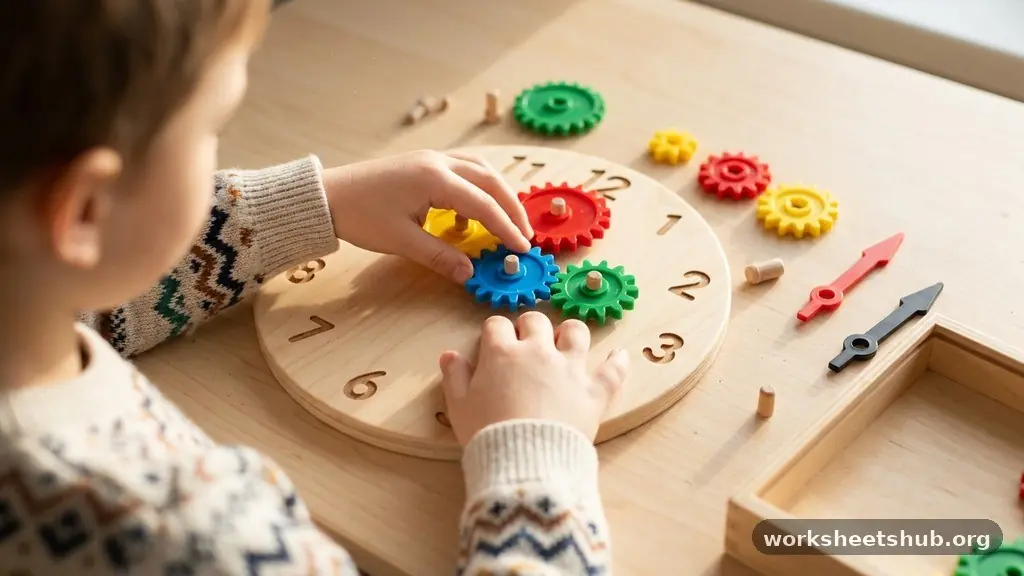
Mastering the skill of reading a clock is a major milestone in a child’s cognitive development, blending abstract logic with daily life. Integrating simple Time-Telling Activities Every Young Learner Can Practice helps children bridge the gap between digital convenience and the foundational geometry of an analog dial. By focusing on consistent, low-pressure engagement, parents and educators can turn the daunting task of deciphering hands and numbers into a rewarding game.
This journey requires patience, as children must learn to map circular motion to linear time. In this article, we explore effective strategies to make these concepts stick through hands-on play and daily observation.
Identifying the Mechanics of an Analog Clock
The primary step in any successful learning program involves identifying the parts of an analog clock. Children often find the transition from a digital clock to a face with three distinct hands confusing.
You should start by isolating the hour hand and the minute hand, as these are the most critical for basic comprehension. Explain that the shorter hand moves slowly, representing the hour, while the longer hand moves more quickly to track minutes.
Once a child can distinguish the hands, focus on the clock face itself. Point out the numbers 1 through 12 arranged in a circle and explain the concept of clockwise rotation. Many children struggle with the idea that time travels in a circle rather than a straight line.
Use a physical object, like a plate with numbers drawn on it, to demonstrate this circular path clearly. This tactile approach reinforces the physical relationship between the numbers and the hands.
Using Manipulative Clocks for Interactive Practice
Manipulative clocks are perhaps the most effective tools for teaching time because they allow children to control the flow of time themselves. Unlike a wall clock that moves on its own, a manipulative clock features hands that can be rotated manually.
This puts the child in the driver’s seat, allowing them to experiment with different time intervals without the pressure of a ticking clock. You can purchase these at most educational supply stores or build a simple version using cardstock and a brass fastener.
Ask your child to “set the time” for specific daily events, such as when they wake up or when dinner is served. This makes the exercise relevant to their own life. As they move the hands, ask them to identify which number the hour hand is pointing toward.
This repetitive motion solidifies the connection between the position of the hand and the numerical value. It also helps them visualize the movement of the second hand if the clock includes one.
Mastering Time Intervals and Vocabulary
Language plays a vital role in understanding how we describe time throughout the day. Terms like quarter past, half past, and quarter to are cultural shorthand that children must memorize alongside the visual mechanics.
You can practice these terms by dividing a paper clock into four equal sections using colored markers. Each section represents fifteen minutes, or a quarter of the hour.
Create a consistent routine where you ask your child to identify these specific intervals during the day. For example, if it is 4:15, point out that the minute hand is at the three and explain the quarter past concept.
By repeating these terms in context, they become part of the child’s natural vocabulary. Consistency is the secret here; using the correct terminology every time you check the time helps normalize these phrases.
Tracking Daily Routines to Build Awareness
Daily routine tracking is a practical way to anchor abstract time concepts to reality. Create a simple chart that lists key parts of the day alongside a picture of a clock showing that time.
You might include milestones such as breakfast, school start time, play time, and bedtime. This helps children see that time is not just a series of numbers but a structure for their day.
When a child sees that 7:00 AM always means breakfast, they begin to associate that specific clock face with a sensory experience. This builds a strong mental model of how long an hour feels.
Encourage your child to predict what time a certain activity will end. This simple guessing game introduces them to the concept of elapsed time in a low-stakes environment.
Comparing Digital and Analog Formats
It is helpful to show children how digital clocks and analog clocks represent the same moment differently. Many modern learners are comfortable with digital displays but lack the spatial reasoning needed for analog dials.
Place a digital clock next to an analog one and ask your child to find the similarities. They will quickly notice that the hour shown on the digital display matches the number the short hand is pointing to.
Use the table below to help children visualize the conversion between these two formats. Seeing the information side-by-side helps them translate the digits they see on a microwave or phone into the spatial positions on a clock face.
| Digital Time | Analog Description | Key Position |
|---|---|---|
| 3:00 | Three o’clock | Minute hand on 12 |
| 3:15 | Quarter past three | Minute hand on 3 |
| 3:30 | Half past three | Minute hand on 6 |
| 3:45 | Quarter to four | Minute hand on 9 |
Visualizing Elapsed Time Through Play
Elapsed time is a complex concept that requires understanding the difference between two points on the clock face. To teach this, use a timer to measure how long a simple task takes, such as building a block tower or reading a book.
Before starting, have the child look at the clock and note the position of the minute hand. After the task, check the clock again to see how far the hand has traveled.
This activity teaches children to calculate duration by counting the minutes between events. It transforms the act of “telling time” into “measuring time.”
You can make this more challenging as their numeracy skills improve by asking them to predict how much time a task will take before starting. This encourages them to think about time as a finite resource that can be managed and tracked.
Games to Reinforce Clock Skills
Gamification is an excellent way to maintain interest when teaching time-telling. One popular game is “What Time Is It, Mr. Wolf?” which uses physical movement to represent the passing of time.
Another option is a scavenger hunt where clues are hidden in envelopes marked with specific times. The child must check the clock to see if it is time to open the next clue.
You can also use card games where children match a card showing a digital time to a card showing an analog clock face. These activities remove the pressure of a formal lesson and allow for organic learning.
When children are having fun, they are more likely to retain the complex spatial rules required to read a clock. Keep the games varied to ensure they aren’t just memorizing patterns but are actually reading the clock face.
Building Numeracy Skills Through Time
Time-telling is inherently linked to math, specifically counting by fives. Since there are 60 minutes in an hour, children must learn to skip-count by five to read the minute hand accurately.
This is a great opportunity to reinforce basic arithmetic while focusing on time. Practice counting around the circle of the clock together, touching each number as you count by five.
This exercise strengthens their ability to recognize how the numbers 1 through 12 function as multipliers for minutes. Once they master skip-counting, reading the clock becomes a much faster process.
It also helps them understand the logic behind the numbers on the face. By connecting math to the clock, you provide a clear, logical reason for why the numbers are positioned the way they are.
Frequently Asked Questions
At what age should a child start learning to tell time?
Most children begin to show interest in the concepts of time between the ages of 5 and 7. At this stage, they are usually developing the necessary numeracy skills to understand counting by fives and circular logic.
Why is learning analog time important in a digital age?
Analog clocks develop spatial reasoning and geometry skills that digital clocks do not. Understanding the physical movement of the hands provides a better grasp of how time passes and how intervals work in a continuous, non-linear way.
How can I help a child who gets frustrated?
If a child feels overwhelmed, step back from the clock and focus on the concept of sequence instead. Use a daily routine chart to show the order of events before worrying about specific numbers on the dial.
How long does it take to learn to tell time?
Every child develops at their own pace, but with consistent, short practice sessions, many children can master the basics within a few months. Focus on progress rather than speed to keep the learning experience positive.
What if my child confuses the hour and minute hands?
This is a very common challenge. Use visual cues like color-coding the hands or creating a mnemonic device to help them remember which hand is which.
Developing Clock Literacy
Mastering the clock is a journey that rewards curiosity and patience. By utilizing simple Time-Telling Activities Every Young Learner Can Practice, you provide the tools necessary for a child to gain independence and confidence. Remember that the goal is not just to read a number, but to understand the rhythm of their own day.
Whether you are using a manipulative clock, tracking daily routines, or playing time-based games, keep the environment supportive and playful. As they grow more comfortable with the mechanics of the clock face, you will see their ability to manage their own schedules improve significantly. Start today by observing the clock together, and enjoy the process of watching their understanding bloom.