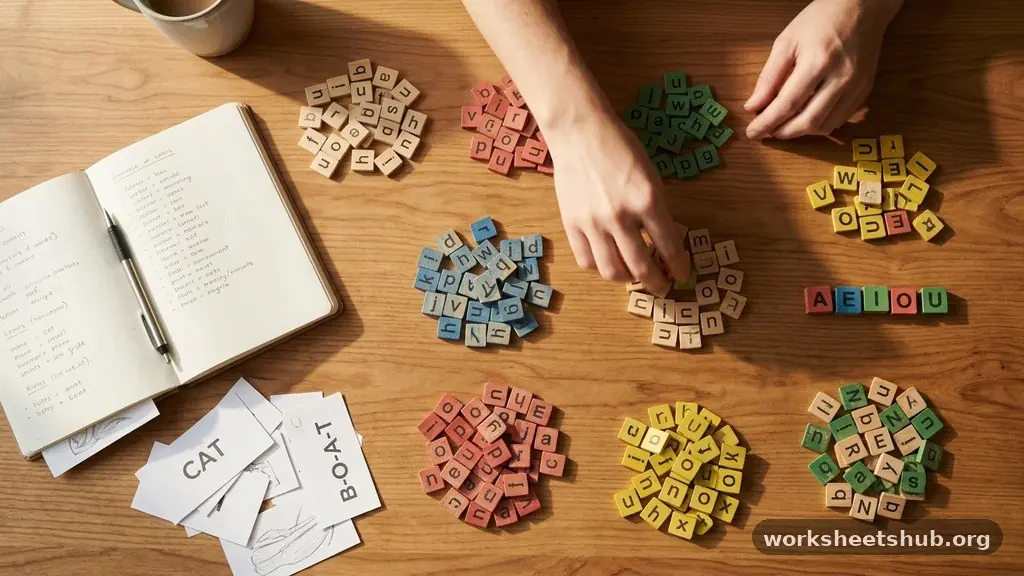
Learning how word sorting games can improve vocabulary skills is a practical way to boost language development without relying on rote memorization. These activities push the brain to move beyond simple recognition, requiring deeper engagement with the internal structures of language. Whether you are a student, an educator, or a lifelong learner, organizing words into logical groups forces your mind to evaluate meaning, sound, and spelling patterns simultaneously.
By actively categorizing terms, you bridge the gap between passive understanding and active usage. This article explores the cognitive mechanics behind these games and offers actionable strategies to integrate them into your daily routine for better linguistic fluency.
The Cognitive Mechanics of Categorization
At its core, the effectiveness of these games lies in how they force the brain to perform active retrieval and classification. When you look at a list of words, your brain isn’t just seeing letters; it is scanning for underlying relationships.
This process of lexical categorization activates the prefrontal cortex, which is responsible for executive functions like decision-making and organization. Instead of simply storing a word in isolation, you are building a network of connections.
When you group words, you are performing a form of mental filing. You might sort by part of speech, root origin, or thematic relevance. This requires you to hold multiple pieces of information in your working memory at once, which strengthens your cognitive processing speed.
The more you practice this, the faster your brain becomes at identifying patterns in new texts. This mental agility is the foundation of long-term vocabulary retention.
Developing Phonemic Awareness Through Sorting
One of the most immediate benefits of word sorting is the development of phonemic awareness. By focusing on how words sound, you begin to notice subtle differences in pronunciation and stress.
For example, sorting words by their vowel sounds or syllable counts forces you to listen to the rhythm of the language. This is particularly helpful for identifying orthographic patterns that might otherwise go unnoticed during casual reading.
Teachers often use these exercises to help learners identify rhyming families or silent letter patterns. When you manually move a word into a specific column based on its sound, you are reinforcing the physical connection between the auditory signal and the written form.
This multi-sensory approach is far more effective than reading a list from a textbook. It creates a stronger memory trace that makes retrieving those words much easier during conversation or writing.
Morphemic Analysis and Word Roots
Sorting words by their morphemes—the smallest units of meaning—is a powerful strategy for expanding your lexicon. By grouping words that share a prefix, suffix, or base root, you learn to decode unfamiliar vocabulary.
If you sort a list of words containing the root “spec” (to look), you quickly realize that spectator, inspect, and perspective all relate to the act of seeing. This insight allows you to make educated guesses about the meaning of new words you encounter in the wild.
This method transforms vocabulary acquisition from a chore into a detective game. Instead of learning one word at a time, you are learning a system that unlocks dozens of others. You stop seeing words as static units and start seeing them as modular components.
This shift in perspective is what separates advanced readers from those who struggle with complex texts. It turns the entire English language into a puzzle you can solve.
Semantic Mapping and Contextual Nuance
Semantic mapping is the process of visualizing the relationships between words based on their meanings. When you engage in sorting tasks that involve synonym grouping or antonym pairs, you are mapping out the landscape of a concept.
You might sort words like “happy,” “joyful,” “elated,” and “content” into a spectrum of intensity. This exercise helps you understand the subtle nuances that distinguish these terms.
Many people have a large passive vocabulary but lack the precision to use the right word at the right time. Sorting games help you refine your word retrieval by highlighting these shades of meaning.
When you compare “cautious” against “timid” or “reckless,” you aren’t just learning definitions; you are learning how to choose the most effective term for a specific context. This clarity is essential for improving your overall communication style.
Categorization Tasks for Language Development
To get the most out of these exercises, it helps to vary the criteria you use for sorting. A static approach will eventually lead to diminishing returns, so you must challenge your brain with new constraints.
You might start by sorting by simple categories, but you should eventually move toward more abstract or complex relationships. Below is a table showing different ways you can categorize a set of words to maximize your learning.
| Sorting Method | Example Criteria | Cognitive Goal |
|---|---|---|
| Orthographic | Words ending in -tion vs -sion | Pattern recognition |
| Morphemic | Words with the root “bio” vs “geo” | Etymological awareness |
| Semantic | Words related to motion vs stillness | Concept mapping |
| Grammatical | Transitive vs intransitive verbs | Syntactic fluency |
Each of these methods forces a different type of mental engagement. By rotating through these categories, you ensure that you are developing a well-rounded set of linguistic skills. You are not just memorizing; you are actively building a versatile mental dictionary.
Building a Personal Word Bank
A word bank is an essential tool for tracking your progress and reinforcing what you have learned. As you encounter new terms in books, articles, or podcasts, add them to your collection.
Once a week, take a subset of these words and perform a sorting task. This keeps the words fresh and forces you to re-evaluate their meanings in relation to one another.
* Select 10-15 words from your current reading list.
* Write each word on a physical index card or in a digital document.
* Sort them into at least three different thematic groups.
* Identify any “outlier” words that don’t fit easily into your categories.
* Look up the etymology of the outliers to see if they belong in a new group.
This simple routine ensures that your vocabulary remains dynamic. It prevents your learning from becoming stagnant and keeps you curious about the structure of language. You can find more resources on language structure at the Reading Rockets website, which offers extensive insights into literacy development.
The Role of Metacognition in Sorting
Metacognition, or thinking about your own thinking, is a key component of effective learning. When you sort words, you should ask yourself why you are grouping them the way you are.
Are you focusing on the sound, the meaning, or the structure? Recognizing your own internal strategy helps you identify blind spots in your knowledge.
If you find that you always sort by definition, challenge yourself to sort by spelling patterns instead. If you find yourself struggling to find a category for a specific word, that is a sign that you need to investigate its definition further.
This reflective practice turns a standard game into a diagnostic tool. You become the architect of your own learning, identifying exactly where your vocabulary gaps exist.
Frequently Asked Questions
Can adults benefit from these games as much as children?
Absolutely. While these games are often introduced in early education, the cognitive benefits—such as improved word retrieval and pattern recognition—are just as valuable for adults. The complexity of the sorting criteria can be scaled to match any proficiency level.
How much time should I spend on word sorting daily?
Consistency is more important than duration. Spending 10 to 15 minutes a few times a week is far more effective than a two-hour marathon session once a month. This keeps the vocabulary top-of-mind and allows for better retention.
Do I need special materials to play these games?
Not at all. You can use index cards, sticky notes, or a simple digital spreadsheet. The power of the game comes from the mental process of categorization, not the materials used to display the words.
What if I don’t know which category a word belongs to?
That is actually a great learning opportunity. When you encounter a word that doesn’t fit, it is a signal to consult a dictionary or a thesaurus. This creates a “teachable moment” that is much more memorable than simply reading a definition.
Are there digital apps that facilitate this?
Yes, there are many flashcard and word-sorting apps available. However, physically writing or typing the words and creating your own categories is generally more effective for memory retention than using pre-made decks.
Refining Your Language Skills
Improving your vocabulary is a lifelong project that benefits from active, intentional practice. By learning how word sorting games can improve vocabulary skills, you gain a versatile tool that works regardless of your starting point.
These games move you away from the passive consumption of definitions and toward a deeper, more structural understanding of how language functions. Whether you are analyzing word roots, mapping semantic relationships, or simply playing with phonemic patterns, you are building a stronger, more flexible mind.
Start small by picking a handful of words from your current reading and sorting them in a way that makes sense to you. As you become more comfortable with the process, increase the complexity and variety of your categories.
Language is a living system, and the more you engage with its internal mechanics, the more confident you will become in your ability to express yourself with precision and flair. Keep sorting, keep questioning, and enjoy the process of expanding your linguistic horizons.