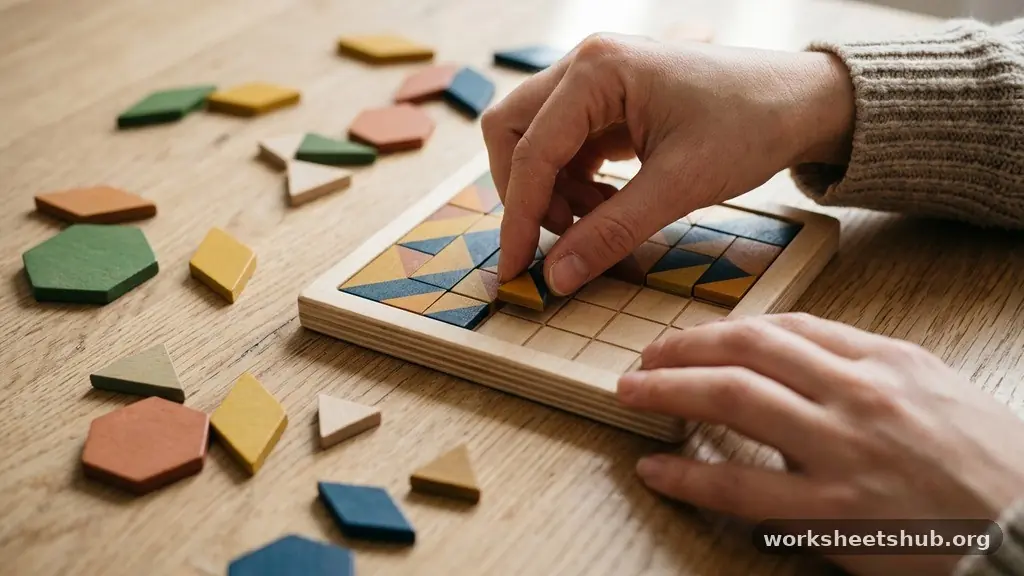
Understanding how matching activities help develop memory and focus provides a clear window into the mechanics of cognitive growth. These exercises require the brain to categorize information, store visual patterns, and retrieve them on demand. By engaging in simple tasks like card games or sorting objects, both children and adults can sharpen their mental acuity.
This article examines the psychological benefits of these practices, offering practical ways to integrate them into your daily routine. Whether you are looking to boost your own concentration or support developmental milestones in others, you will find actionable insights here on how these consistent mental challenges improve overall brain health and cognitive efficiency.
The Cognitive Mechanics of Matching
Matching activities are fundamentally about pattern recognition and visual discrimination. When a person looks at two items to determine if they are identical, they engage multiple regions of the brain simultaneously.
The occipital lobe processes the visual data, while the frontal lobe manages the executive function required to make a decision. This process forces the brain to isolate specific details like color, texture, or shape.
By practicing these tasks, you are essentially training your neural pathways to become more efficient at filtering irrelevant stimuli. This filtering is the hallmark of sustained concentration.
When the brain learns to ignore “noise” in a matching game, it becomes better at ignoring distractions in real-world scenarios. This is why individuals who frequently engage in these activities often report improved clarity during complex tasks.
Categorization and Working Memory
The ability to categorize information is a core component of higher-order thinking. Matching activities require you to hold one piece of information in your mind while scanning for its counterpart.
This is a classic test of working memory, the system responsible for temporary storage and processing of information. As you improve, you can manage more complex sets of items, such as multi-part patterns or abstract symbols.
Working memory is often described as the “mental workspace” of the brain. When you increase the capacity of this workspace through regular practice, you improve your ability to remember instructions, follow multi-step processes, and keep track of goals.
This is particularly beneficial in high-pressure environments where information must be processed quickly. The more you practice, the more “space” you gain in your mental workspace.
Strategies for Children
For children, the developmental benefits of matching are profound. These games serve as a foundational tool for building early literacy and numeracy skills.
When a child matches a letter to a sound or a shape to its outline, they are reinforcing cognitive associations. These connections form the bedrock for more complex academic learning later on.
Parents and educators often use tactile items like fabric swatches or wooden blocks to make the process more engaging. These physical objects help children develop spatial awareness, which is the ability to understand how objects exist in space relative to one another.
This spatial understanding is critical for later success in subjects like geometry and physics. Here are a few ways to structure these activities:
- Use varying levels of difficulty, starting with identical pairs and moving to thematic matches.
- Integrate physical movement by hiding items around a room to combine memory with motor skills.
- Incorporate time-based challenges to increase the pressure and demand for sustained focus.
- Rotate materials frequently to ensure the child remains challenged rather than just memorizing static positions.
Strategies for Adults
For adults, the focus shifts toward maintaining cognitive reserve and preventing mental fatigue. While children use matching to build new pathways, adults use these activities to reinforce existing ones and improve processing speed.
The challenge lies in finding activities that are sufficiently complex to prevent boredom. Sophisticated puzzles, memory card games, or even professional tasks like sorting data sets can serve this purpose.
The goal for adults is to push the boundaries of their current focus. If a game becomes too easy, it no longer provides a cognitive benefit.
You must constantly seek out new patterns or larger sets of data to process. This ongoing adaptation is what keeps the brain plastic and resilient against the natural decline associated with aging.
Data Comparison of Cognitive Engagement
To understand the impact of these activities, it helps to look at how different levels of complexity affect the brain. The following table illustrates how varying the number of items in a matching task influences the cognitive load and the resulting mental engagement.
| Complexity Level | Item Count | Primary Cognitive Benefit |
|---|---|---|
| Beginner | 4-8 pairs | Visual pattern recognition |
| Intermediate | 12-20 pairs | Working memory expansion |
| Advanced | 30+ pairs | Sustained focus and attention |
| Expert | Complex patterns | Executive function and logic |
The Role of Spatial Awareness
Spatial awareness is often overlooked, yet it is a critical pillar of cognitive development. Matching games that involve physical layouts force the brain to map the environment.
You must remember where you saw a specific card or object, which requires constant spatial updates. This process strengthens the hippocampus, the area of the brain most closely associated with memory and navigation.
When you practice these skills, you are effectively building a better internal map of your surroundings. This translates to better coordination and a deeper understanding of geometric relationships.
Even simple activities like organizing a desk or sorting laundry can be turned into a spatial memory exercise. The more you consciously engage with the position of items, the more you refine your spatial processing abilities.
Consistency and Long-Term Results
The benefits of these activities are cumulative. Just as physical exercise strengthens muscles over time, mental exercises strengthen cognitive pathways through repetition.
Consistency is far more important than intensity. Spending ten minutes every day on a matching task is significantly more effective than spending three hours once a week.
You might find it helpful to view these tasks as a form of mental hygiene. By setting aside time to sharpen your focus, you are investing in your long-term mental clarity.
The National Institute on Aging suggests that staying mentally active is a key factor in supporting brain health throughout the lifespan. By keeping your mind engaged with varied tasks, you ensure that your cognitive functions remain sharp and responsive even as you age.
FAQ: Common Questions on Cognitive Training
Does the difficulty of the game matter for cognitive growth?
Yes, the difficulty level is essential. If a task is too simple, your brain operates on “autopilot,” which provides little to no cognitive benefit. You need to choose activities that are challenging enough to require effort but not so difficult that they cause significant frustration.
Can adults really improve their memory through these games?
Adults can certainly improve their processing speed and focus. While you cannot necessarily “grow” new memory storage in the same way a child does, you can improve the efficiency with which you use your existing mental resources. This leads to better recall and improved attention spans.
How long does it take to see results?
Most individuals report feeling more alert after just a few sessions. However, lasting improvements in memory and focus usually require weeks or months of consistent practice. Think of it as a long-term habit rather than a quick fix.
Are digital games as effective as physical ones?
Both have their merits. Physical games are excellent for developing fine motor skills and spatial awareness. Digital games are often better at tracking progress and providing immediate, quantifiable feedback on your performance.
Should I focus on speed or accuracy?
Always prioritize accuracy first. Speed is a byproduct of mastery; if you rush, you sacrifice the depth of cognitive processing that makes these activities useful. Once your accuracy is consistent, you can slowly begin to increase the pace of your practice.
Building a Sustainable Routine
Integrating these practices into your life does not require a massive time commitment. Start by identifying small windows in your day where you can introduce a quick matching exercise.
This could be while waiting for a meeting, during a lunch break, or as a way to wind down before bed. The key is to make it a natural part of your schedule rather than a chore.
By focusing on how matching activities help develop memory and focus, you can transform simple leisure time into a productive mental workout. Pay attention to how your brain feels during and after these tasks.
You will likely notice a greater sense of calm and a higher level of alertness. Stay curious, keep challenging your patterns, and enjoy the process of strengthening your mind.