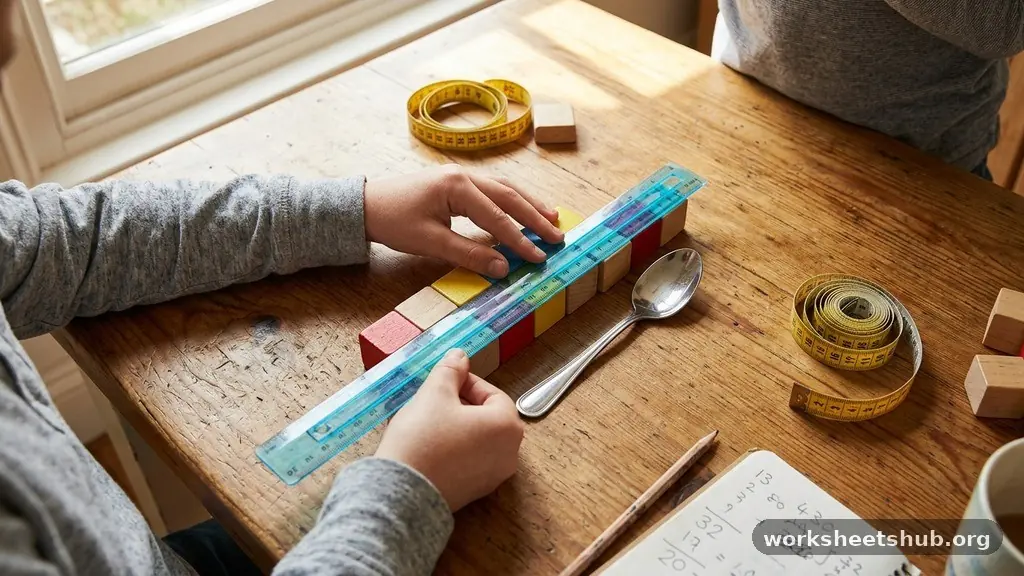
Engaging children with math through fun measurement activities using everyday household objects is a practical way to build spatial reasoning and numerical literacy. By moving beyond abstract textbook problems, you transform the kitchen or living room into a laboratory for hands-on learning. Whether you are comparing lengths of kitchen utensils or calculating the volume of a bathtub, these exercises bridge the gap between theoretical concepts and the physical world.
This approach demystifies standard units and introduces the importance of consistency in scientific inquiry. You will find that simple items like spoons, books, and toys provide the perfect tools for exploring the fundamentals of the metric system and imperial system at home.
The most effective way to start is by introducing non-standard measurement, which allows children to grasp the core concept of units before moving to standardized tools. If you want to know how long a kitchen table is, ask your child to measure it using a shoe or a wooden block instead of a ruler. This highlights the necessity of using a consistent unit to get a reliable result.
Once they understand why their hands or feet might yield different measurements than yours, they are ready to appreciate the precision of a measuring tape or a ruler. The following sections explore specific ways to turn your home into a hub for these mathematical discoveries.
Exploring Length and Height with Household Items
Measuring length is the most intuitive starting point for children because it relates directly to the physical space they occupy. You can begin by having your child measure the height of their favorite stuffed animals or the length of the sofa using common items like paperclips, LEGO bricks, or books.
These non-standard units help them develop a sense of scale and proportion. When they realize that it takes twenty paperclips but only two books to cross the same distance, they begin to understand how the size of a unit affects the total count.
Transitioning to standard units is the next logical step in this developmental process. Once they have mastered the concept of “how many units long,” introduce a standard ruler or a retractable measuring tape to see how the numbers change. You might ask them to predict how many centimeters a toy car measures before confirming with the tool.
This practice of estimation is a critical skill that helps learners internalize the relationship between numbers and physical reality. It also provides a great opportunity to compare the metric system—using millimeters and centimeters—against the imperial system of inches.
Understanding Mass and Weight in the Kitchen
The kitchen is a treasure trove for exploring mass and weight, primarily because it is filled with tools designed for precision. A digital kitchen scale is your best asset here, as it provides immediate feedback on the weight of various pantry items.
You can start by weighing bags of flour, boxes of pasta, or even pieces of fruit to see how different objects have varying densities. This activity helps children realize that size does not always correlate with weight, as a small lead weight might be heavier than a large bag of cotton balls.
To make this more interactive, set up a “weighing station” where children must predict which item is heavier before placing it on the scale. You can create a simple table to track their guesses and the actual measurements to see how their accuracy improves over time. This process reinforces the importance of using standardized units like grams and ounces.
It also encourages them to think about how ingredients in recipes are balanced to create a final product. Exploring these concepts helps them grasp why baking is often considered a science rather than just a culinary art.
Mastering Volume and Capacity
Capacity refers to the amount of liquid or dry material a container can hold, and it is a fascinating concept to observe in action. Using measuring cups, clear glasses, and various bowls, you can show how different shapes can hold the same total volume.
Start by filling a measuring cup with water and pouring it into a tall, thin glass versus a short, wide bowl. The water level will look different in each, which often surprises young learners and sparks a conversation about how shape influences appearance.
This activity is a perfect introduction to the concept of displacement. If you submerge a small toy into a full cup of water, the amount of water that spills out equals the volume of the toy. This is a classic scientific observation that dates back to Archimedes and remains a powerful way to visualize abstract volume.
You can find more structured ideas for these types of experiments through the National Institute of Standards and Technology, which provides authoritative information on measurement systems. Understanding these principles helps children realize that volume is a property of objects that can be quantified and compared.
Comparing Measurement Tools and Accuracy
Not all tools are created equal, and learning to choose the right instrument is a vital part of mathematical maturity. A measuring tape is excellent for large, flexible surfaces, while a rigid ruler is better for flat, hard edges. You can demonstrate this by having your child attempt to measure the circumference of a ball with a flat ruler.
They will quickly discover the challenge of keeping the ruler against a curved surface. This failure is a teaching moment that leads to the realization that specialized tools are designed for specific tasks.
You can also compare the precision of different methods by measuring the same object multiple times. For example, have them measure a doorway using a yardstick and then again using a shorter ruler. They will likely notice that the more times they move the tool, the higher the chance of a small error creeping into their total count.
This helps them understand the concept of cumulative error and the value of using a single, long tool whenever possible. Such practical experiences build a deeper respect for precision and careful technique.
Spatial Reasoning Through Construction
Measurement is not just about numbers; it is about understanding how objects fit into space. Using building blocks or cardboard boxes, you can challenge your child to construct a tower that reaches a specific height measured in centimeters. This requires them to plan, measure, and adjust their work as they go.
If their tower is too short, they must calculate how many more blocks are needed to reach the target. This turns a simple building activity into a complex exercise in spatial reasoning and arithmetic.
You can also introduce the concept of area by using square tiles or sheets of paper to cover a tabletop. By counting how many squares it takes to fill the surface, they learn that area is a two-dimensional measurement. If you have different sized tiles, ask them if it takes more or fewer of the larger ones to cover the same area.
This reinforces the inverse relationship between the size of a unit and the number of units required to fill a space. It is a fundamental lesson that serves them well in geometry and architecture later in life.
Data Collection and Household Comparisons
Organizing information into a clear format is the final step in making sense of measurement activities. Encourage your children to record their findings in a notebook or on a whiteboard. When they compare the weights or lengths of different household objects, a simple table can make the differences immediately obvious.
This practice teaches them how to present data clearly, which is a core skill in both mathematics and the sciences. Below is an example of how you might organize a simple comparison of household objects.
| Object | Measurement Type | Value (Metric) |
|---|---|---|
| Large Soup Can | Mass | 425 grams |
| Kitchen Spatula | Length | 30 centimeters |
| Coffee Mug | Capacity | 350 milliliters |
| Cereal Box | Height | 28 centimeters |
Common Challenges and How to Overcome Them
One frequent hurdle in these activities is the frustration that comes with inconsistent results. If a child measures the same table twice and gets two different numbers, they might feel like they are “failing.” Instead of correcting them, ask them to identify where the mistake happened.
Did the ruler slip? Did they start at the wrong mark? These questions shift the focus from the result to the process, which is where the real learning occurs.
Another challenge is the difficulty of switching between the metric and imperial systems. It is common for children to feel overwhelmed when they encounter inches on one side of a ruler and centimeters on the other. Acknowledge that these are simply two different languages for describing the same physical world.
You do not need to push for mastery of conversions immediately; focus instead on the fact that both systems are just ways to be consistent. Keeping the atmosphere light and playful ensures that the focus remains on exploration rather than rigid testing.
Frequently Asked Questions
At what age should I start these activities?
You can introduce basic concepts of “bigger” and “smaller” as early as age three or four. By age six or seven, children are usually ready to start using rulers and scales for more formal measurement tasks.
How do I handle mistakes in measurement?
Treat mistakes as data points rather than failures. Ask the child to re-measure and explain why the two results might be different, which encourages critical thinking and attention to detail.
Do I need to buy expensive equipment?
Not at all. The best tools are often the ones you already have in your kitchen or garage. Measuring cups, standard rulers, and bathroom scales are perfectly sufficient for almost all household math activities.
How can I make this more challenging for older children?
For older kids, introduce concepts like area and volume formulas. You can also ask them to calculate the density of an object by dividing its mass by its volume, or have them map out the dimensions of a room to scale.
Are these activities suitable for a group setting?
Yes, these work well for siblings or small groups of friends. You can turn them into a competition where teams have to estimate and then measure the dimensions of various items in the house to see who is closest to the actual value.
Conclusion
Engaging in fun measurement activities using everyday household objects provides a lasting foundation for mathematical thinking. By turning common items into tools for discovery, you help your children see that math is not just something on a page, but a way to interact with the world around them. Whether you are weighing ingredients for a cake or calculating the height of a bookshelf, these moments build confidence and curiosity.
Start with simple observations and let the complexity grow as their understanding deepens. You will find that these simple, hands-on experiences turn math into an enjoyable part of your daily routine, encouraging a lifelong love for learning and exploration.