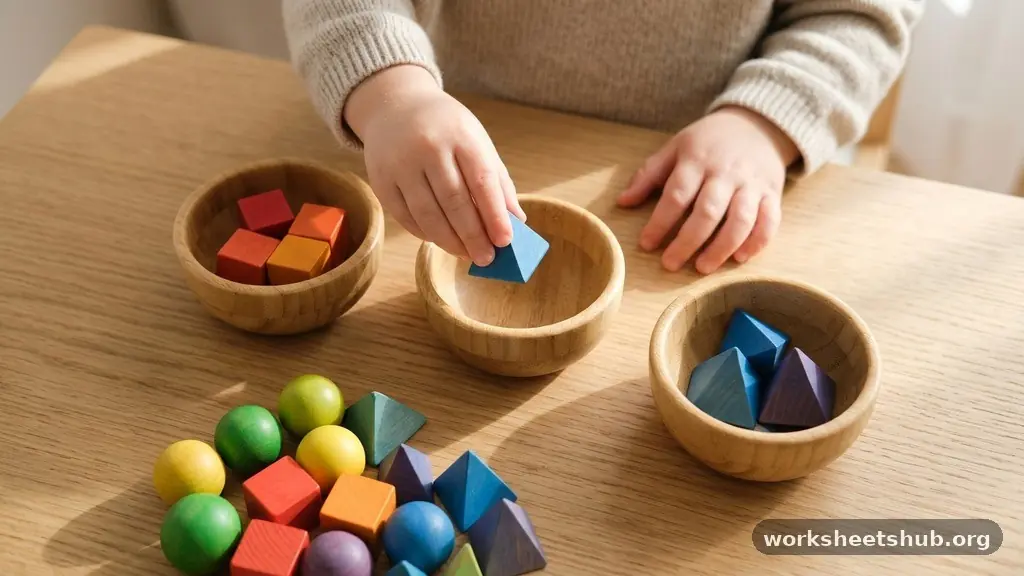
Understanding how sorting and grouping activities build early math skills is a cornerstone of effective early childhood education. When young children organize objects by color, shape, or size, they are not just playing; they are laying the groundwork for complex logical thinking and numeracy. These simple interactions with the physical world help children transition from concrete observations to abstract mathematical concepts.
By engaging in these exercises, you provide the essential scaffolding for future success in quantitative analysis and pattern recognition. This article explores the cognitive mechanics behind these activities and how they translate into long-term academic growth.
The Cognitive Foundation of Classification
At the heart of early mathematical development lies the ability to perceive similarities and differences. When a child identifies that two blue blocks belong together, they are performing a fundamental act of logical thinking.
This process of classification is the first step toward understanding sets and subsets, which are essential components of formal algebra and arithmetic. By grouping items, children learn to ignore irrelevant details—like the texture of a block—and focus on the defining attribute, such as its color.
This cognitive shift is a vital part of developing executive function. It requires the child to hold multiple pieces of information in their mind and decide which category an object fits into.
You are essentially training their brain to process data systematically, a skill that will serve them well in every subject area as they grow. This mental sorting is the precursor to the more advanced mathematical reasoning they will encounter in elementary school.
Tactile Learning and Mathematical Reasoning
Tactile learning is perhaps the most effective way to introduce these concepts to young learners. When children physically move objects, they engage their senses, which helps cement the abstract rules of logic in their memory.
Manipulative materials like buttons, plastic animals, or colored beads provide a concrete representation of numbers and groups. These physical interactions allow children to experiment with different arrangements without the pressure of paper-and-pencil tasks.
During these sessions, children often start by creating simple piles, but they eventually move toward more complex organization. They might arrange items in rows or circle them to define a set, which introduces the concept of spatial awareness.
This physical manipulation is not just about fine motor skills; it is about building a mental map of how things relate to one another. When they see that a group of five bears can be sorted into two groups of three and two, they are intuitively grasping addition and subtraction.
Developing Numerical Literacy Through Sets
The transition from sorting to counting is seamless when you use the right materials. As children group objects into sets, they naturally begin to count the number of items in each collection.
This is where the concept of subitizing—the ability to instantly recognize the quantity of a small group of items—begins to take root. By regularly interacting with sets of three, four, or five objects, children stop needing to count every single piece one by one.
This efficiency is a major milestone in early numeracy. When they see a group of four blocks, they eventually recognize “four-ness” without needing to touch each one.
This recognition is a critical step in moving toward formal mathematical notation. By encouraging them to sort objects into groups of different sizes, you help them understand that numbers represent quantities of things in the real world.
The Role of Pattern Recognition
Sorting activities often lead directly into the discovery of patterns. Once a child understands how to group items by a single attribute, they can start creating sequences, such as red-blue-red-blue.
Pattern recognition is the bridge between basic classification and algebraic thinking. It requires the child to predict what comes next based on the order they have established.
Identifying these repeating sequences helps children understand the structure of mathematics. Whether they are sorting by size or alternating colors, they are learning that math is predictable and rule-based.
This discovery fosters a sense of confidence and curiosity. You can find more information on the developmental stages of these skills at the National Association for the Education of Young Children.
Categorical Thinking and Data Organization
As children progress, they move from simple sorting into more complex categorical thinking. This involves identifying attributes that aren’t immediately obvious, such as sorting objects by whether they roll or slide.
This type of investigation encourages children to ask questions and test their hypotheses. It is the beginning of the scientific method applied to mathematical objects.
The following table demonstrates how different sorting criteria help children develop varying levels of analytical depth.
| Sorting Criterion | Mathematical Concept | Cognitive Benefit |
|---|---|---|
| Color or Shape | Set Theory | Visual Discrimination |
| Size (Small to Large) | Seriation | Comparative Analysis |
| Function (Roll vs. Slide) | Data Categorization | Hypothesis Testing |
| Number of Corners | Geometry | Attribute Identification |
Building Executive Function Through Games
Structured play is an excellent way to reinforce these concepts without making them feel like a chore. You can turn simple household items into a game that challenges the child to sort items under time pressure or according to complex rules.
These games help improve focus and working memory, which are key components of executive function. When a child must sort a mix of kitchen utensils by their use, they are exercising their brain’s ability to filter information.
There are many ways to keep these activities engaging and fresh for young learners:
- Use diverse materials like leaves, rocks, or coins to show that math is everywhere.
- Introduce “mystery” sorting where the child has to guess your rule for grouping objects.
- Create a “sorting race” to see how quickly they can organize items into specific bins.
- Encourage them to explain their logic, which reinforces their verbal reasoning skills.
- Challenge them to create a new category that no one else has thought of yet.
The Connection to Quantitative Analysis
While sorting often feels like a qualitative exercise, it is actually deeply connected to quantitative analysis. When you ask a child to sort items into “more than five” and “fewer than five,” you are introducing them to the concept of inequalities.
This is a direct precursor to the symbols and equations they will use later. The ability to compare the size of different sets is a foundational skill for understanding fractions and ratios.
Even at a young age, children can grasp the idea that one group is bigger than another. By providing them with these opportunities, you are helping them build a “number sense” that goes beyond rote memorization.
They are learning to think like mathematicians, analyzing the relationship between the quantities they see. This deep understanding makes later mathematical topics much more accessible and less intimidating.
Encouraging Independent Mathematical Exploration
The ultimate goal of these activities is to foster a sense of autonomy in the child’s learning. When they start sorting their own toys or organizing their books by size, they are applying the skills they have learned.
This independence is a sign that they have internalized the concepts of classification and order. It turns the home or classroom into a laboratory for mathematical discovery.
You don’t need expensive equipment to encourage this behavior. Simple everyday objects are often the best tools for teaching these fundamental concepts.
By providing the time and space for this exploration, you are validating their natural curiosity. This approach builds a positive association with mathematics that can last a lifetime, ensuring they view themselves as capable learners.
Frequently Asked Questions
At what age should children start sorting activities?
Most children begin to show an interest in sorting and grouping as early as age two. You can start with very simple tasks, like putting all the red blocks in one pile and all the blue blocks in another, as soon as they can grasp objects independently.
How do I know if the activities are too easy or too hard?
If a child is bored or finishes instantly, the task is likely too easy; try adding a second attribute, like sorting by both color and shape. If they become frustrated or lose interest quickly, simplify the task by reducing the number of categories or the variety of objects being sorted.
Do these activities really help with later school subjects?
Yes, the logical foundations built through sorting are directly linked to success in subjects like science and computer programming as well as math. The ability to organize information and recognize patterns is a universal skill that helps in virtually every academic discipline.
Can I use digital apps instead of physical objects?
While digital games can reinforce concepts, physical objects are superior for young children because they engage multiple senses. The tactile experience of moving items is crucial for building the neurological pathways that support early mathematical understanding.
How long should a typical sorting session last?
Keep these activities short and sweet, usually between 5 and 15 minutes. The goal is to keep the child engaged and curious rather than exhausted, so stop while they are still enjoying the process.
Conclusion
Building a strong mathematical foundation is a journey that starts with the simplest observations. By understanding how sorting and grouping activities build early math skills, you can provide the right environment for children to thrive. These activities do more than teach counting; they develop the logical, analytical, and executive functions that define successful learners.
As you integrate these practices into your daily interactions, remember that the process is just as important as the result. Whether you are sorting laundry by color or organizing toys into baskets, you are teaching essential life skills.
Keep the environment supportive and playful, and you will see your child gain confidence in their own mathematical reasoning. Start small, stay consistent, and enjoy watching their minds grow as they make sense of the world around them.