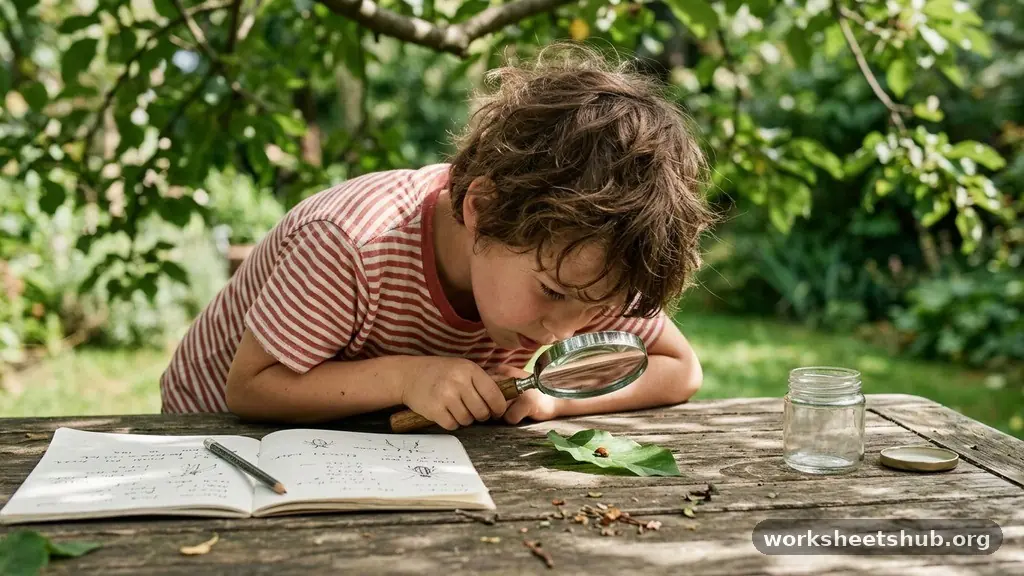
Engaging with simple Science Activities That Encourage Children to Ask Questions is one of the most effective ways to nurture a lifelong love for discovery. By shifting the focus from memorizing facts to exploring how the world functions, parents and educators can transform everyday moments into powerful learning opportunities.
These activities prioritize wonder over rigid academic outcomes, allowing children to develop critical thinking skills naturally. When we provide space for a child’s inherent curiosity to lead the way, we are not just teaching them about biology or physics; we are equipping them with the tools to investigate, analyze, and understand the complex environment around them.
The most direct way to foster this curiosity is to stop providing immediate, definitive answers to every inquiry. Instead, when a child asks why the sky is blue or how a plant grows, turn the query back toward them. This approach, which is often known as the Socratic method, encourages the child to form their own theories based on what they see.
By inviting them to share their initial thoughts, you validate their perspective and push them to look closer at the world. This simple change in communication creates a foundation for inquiry-based learning that lasts well beyond the early childhood years.
The Role of Observational Play
Observational play serves as the bedrock of early scientific engagement. It involves setting aside time for children to look at, touch, and describe objects in their environment without the pressure of a specific goal.
You might take a walk in a local park and ask your child to find three things that look different from one another. By focusing on textures, colors, and shapes, you are helping them build a visual vocabulary that is essential for later hypothesis testing.
When children spend time observing, they naturally begin to notice patterns. They might see that shadows change length throughout the day or that ants follow specific paths toward food. Encouraging them to keep a simple nature journal can solidify these observations.
Even if the journal consists of nothing more than crude drawings and scribbles, the act of recording what they see teaches them that their observations hold value. This is the first step toward understanding that data collection is a vital part of the scientific process.
Reframing the Parent-Child Dialogue
Changing how you speak to your children during play can dramatically shift their engagement levels. Rather than acting as the source of all knowledge, try to position yourself as a fellow explorer.
If a child asks why a ball rolls down a hill, you might respond by asking what they think would happen if the hill were steeper. This type of Socratic questioning forces them to think through potential outcomes before they occur.
It is important to avoid correcting their misconceptions too quickly. If a child incorrectly assumes that a heavy rock will always fall faster than a light leaf, let them test it.
Allowing them to experience the reality of the outcome is far more memorable than hearing a lecture on gravity. By facilitating this type of dialogue, you reinforce the idea that science is not about being right the first time, but about refining ideas through experience.
Designing Low-Stakes Experiments
You do not need an expensive kit to conduct meaningful scientific work at home. Most effective activities utilize household items that are already sitting in your kitchen or backyard.
For example, floating and sinking experiments are incredibly simple but highly effective at sparking questions. You can fill a bucket with water and ask your child to predict whether common objects like a spoon, a plastic toy, or a piece of fruit will sink or float.
The value of this activity lies in the prediction stage. Before any item touches the water, ensure your child voices their hypothesis aloud.
You can even create a simple chart to track their predictions versus the actual results. This practice directly mirrors the scientific method, where a researcher makes a prediction and then tests it against reality.
| Activity | Primary Concept | Typical Question |
|---|---|---|
| Sink or Float | Density/Buoyancy | Why did the orange float but the grape sink? |
| Shadow Tracking | Earth Rotation | Why does my shadow move when I stand still? |
| Plant Growth | Photosynthesis | Does the plant need light to get taller? |
| Baking Soda Volcano | Chemical Reaction | What makes the bubbles happen? |
Developing the Scientific Mindset
A scientific mindset is less about knowing the answers and more about having the persistence to keep looking. You can foster this by modeling curiosity in your own life. If you encounter a problem, such as a broken appliance or a dying houseplant, share your thought process with your child.
Explain what you are observing and what you plan to do to fix it. This transparent approach shows them that adults are also constantly learning and adapting.
The National Science Teaching Association emphasizes that early exposure to inquiry-based experiences builds confidence in children. When they see that you are willing to experiment and potentially fail, they become much less afraid to take risks in their own play.
This emotional resilience is just as important as the factual knowledge they gain. It allows them to view failure not as a stop sign, but as a piece of useful information that helps them refine their next attempt.
Encouraging Curiosity-Driven Learning
Curiosity-driven learning thrives when children are given autonomy over their projects. Instead of prescribing a rigid list of tasks, allow them to choose which natural phenomena they want to investigate.
If they are fascinated by bugs, help them set up an observation station in the backyard. If they are obsessed with water, let them experiment with different containers and pouring techniques.
This freedom allows children to build a deep, intuitive understanding of the world that is far more durable than memorized facts. When a child chooses the topic, they are inherently more invested in finding the answers.
Your role is simply to provide the resources and the encouragement to keep them moving forward. By supporting their interests, you demonstrate that their questions are worth investigating, which builds their self-esteem and intellectual independence.
The Importance of Hands-On Experimentation
Abstract concepts become concrete when children can manipulate materials with their own hands. Hands-on experimentation bridges the gap between seeing something happen and understanding why it happened.
For instance, instead of explaining how soil works, let your child plant two sets of seeds—one in rich potting soil and one in sand. Watching how the plants develop differently provides a visceral lesson in environmental needs.
* Always keep a notebook for recording observations and drawings.
* Use magnifying glasses to inspect tiny details on leaves or insects.
* Encourage the use of measuring tools like rulers or kitchen scales.
* Allow for “messy” play as it often leads to unexpected discoveries.
* Ask “What if?” questions to encourage imaginative testing.
These tactile experiences are vital because they engage multiple senses. When a child smells the soil, feels the texture of the seeds, and sees the difference in growth rates, the information is encoded in their memory much more effectively. This multisensory approach is a cornerstone of effective education, especially for young learners who are still developing their abstract reasoning skills.
Building Critical Thinking Skills
Critical thinking skills emerge when children are asked to analyze the data they have collected. After an experiment, ask them to describe not just what happened, but why they think it happened. This forces them to synthesize their observations into a coherent explanation.
If their explanation is incorrect, do not jump in to correct it immediately. Instead, ask a follow-up question that might lead them to reconsider their initial assumption.
For example, if they conclude that the plant in the sand died because it was “lonely,” you might ask how plants get their food. By pointing them toward the role of nutrients in soil, you are guiding them toward a more scientific explanation without stripping them of their agency.
This process of refinement is the essence of critical thinking. It teaches them that their first idea is only the starting point for a deeper understanding.
FAQ: Common Questions
How can I encourage my child to ask more questions?
The best approach is to model curiosity yourself. When you are out in the world, talk about what you see and what you are wondering about. If your child is quiet, try asking open-ended questions like “What do you think happens when it rains?” or “Why do you think that bird is singing?”
What if I don’t know the answer to their scientific question?
Admitting that you don’t know is a powerful teaching moment. It shows your child that even adults are continuous learners. You can say, “That is a great question, let’s see if we can find out together,” and then look it up in a book or on a reputable website.
How much time should I dedicate to these activities?
Science does not need to be a formal block of time in your day. It is best integrated into the things you are already doing, like cooking, gardening, or walking the dog. Even five or ten minutes of focused observation can be highly productive.
Is it okay to let them experiment with things that might break?
Supervised risk is part of learning. As long as the environment is safe, let them test the limits of their materials. If they are curious about how a gear works, let them take apart an old clock. The goal is to encourage the desire to understand how things function.
What if my child loses interest in an experiment halfway through?
That is perfectly fine. Children learn at their own pace, and sometimes they get what they need from an activity long before we think they should. Forcing them to finish a project can turn a fun discovery into a chore.
Conclusion
Engaging in simple Science Activities That Encourage Children to Ask Questions is a journey that benefits both the adult and the child. By prioritizing wonder, patience, and active exploration, you create an environment where learning feels natural and rewarding.
You are not merely filling their minds with data; you are teaching them how to process the world with clarity and confidence. Every question they ask is a step toward a more sophisticated understanding of their surroundings.
Start small by simply observing the world together and asking what you both see. As you continue to practice these habits, you will find that the dialogue between you becomes richer and more complex.
Embrace the uncertainty, enjoy the process of discovery, and keep the conversation going. Your support is the most important tool they have as they learn to navigate the mysteries of the natural world.