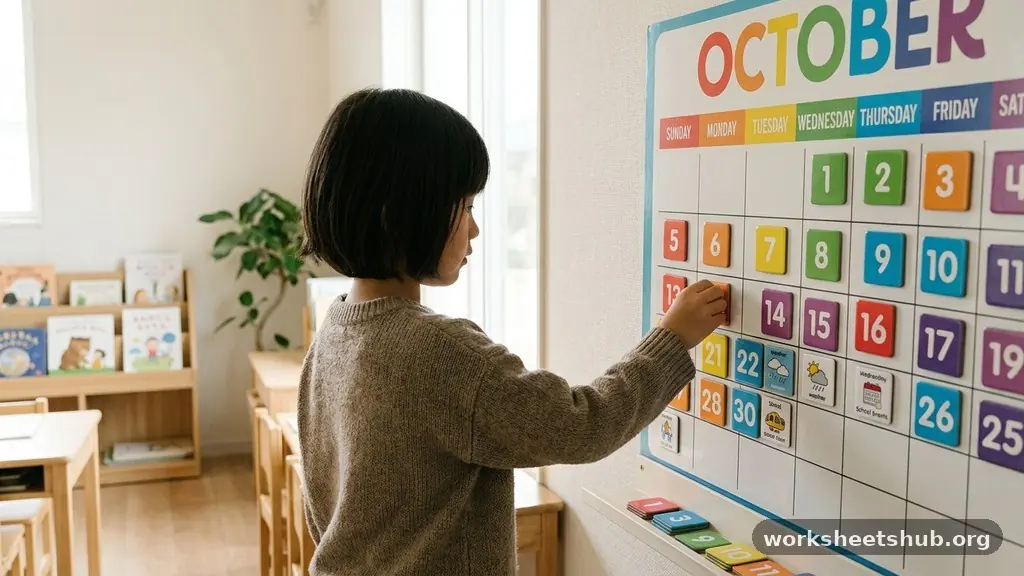
Engaging children with the passage of time is a cornerstone of early childhood education. By incorporating fun calendar activities for learning days, weeks, and months into a daily routine, educators and parents can help children build essential temporal awareness. These activities transform abstract concepts like “yesterday,” “tomorrow,” and “next month” into tangible, predictable patterns.
Whether you are using a physical classroom display or a digital interface, the goal is to make time feel like a friendly, manageable structure. This article provides practical, hands-on strategies to help young learners master the calendar while developing foundational skills in sequencing, observation, and logical thinking.
The Foundation of Temporal Awareness
The primary way children grasp the passage of time is through consistent, daily interaction with a calendar. When children engage in fun calendar activities for learning days, weeks, and months, they are essentially performing “calendar math” every single morning.
This practice involves counting the days, identifying the current date, and predicting what comes next. By repeating these tasks, children move from simple memorization to a deeper understanding of how time functions in a cycle.
Consistency is the most important factor when teaching these concepts. If you only look at the calendar once a week, the pattern remains invisible to a young learner.
Making it a part of the morning meeting or the first task of the school day ensures that the concept of a “date” becomes a habitual part of their cognitive landscape. Over time, this builds the internal clock needed for more complex organizational skills later in life.
Mastering Days of the Week
Learning the sequence of the seven days is often the first hurdle for young children. Instead of just chanting the names, use visual cues to anchor each day to a specific event.
For example, if “Music Monday” or “Library Tuesday” is a recurring event, the child begins to associate the name of the day with a specific activity. This connection helps solidify the order of the days through functional memory rather than rote memorization.
Another effective method involves using a “Days of the Week” train or a linear chart. Place the days in a horizontal line rather than a traditional grid to help children visualize the progression of a week as a continuous path.
Ask questions like, “If today is Wednesday, what day was it yesterday?” or “How many sleeps until the weekend?” These questions force the brain to engage with sequencing skills and the relative nature of time.
Understanding Months and Seasonal Cycles
Moving beyond the week, the twelve months of the year can feel overwhelming to a child. The best approach is to link months to seasonal changes and major holidays.
By color-coding the months based on the four seasons, you provide a visual aid that helps children categorize time. For instance, December, January, and February might be colored in icy blues and whites, while June, July, and August are represented by sunny yellows and greens.
Seasonal activities provide a natural context for discussing the passage of time. You might track the weather daily, noting how the temperature shifts as you move from one month to the next.
This weather tracking activity bridges the gap between abstract calendar dates and the physical environment the child experiences every day. It teaches them that time is not just a series of numbers, but a rhythmic cycle of change in the world around them.
Integrating Patterns and Skip Counting
Calendar math offers an excellent opportunity to reinforce early numeracy skills. Every month, the dates follow a predictable pattern.
You can use this to teach skip counting by focusing on the days of the week or by highlighting specific patterns in the calendar grid. For example, if you mark every seventh day with a special sticker, you are naturally introducing the concept of multiples and patterns.
Interactive whiteboards or digital calendars allow for even more dynamic pattern-making. You can change the shape or color of the number cards to create an “A-B-A-B” pattern that children must predict.
When they correctly guess that a square comes after a circle, they are practicing the same logical reasoning required for later mathematical success. These small, daily challenges keep the calendar activity fresh and mentally stimulating.
Using Mnemonic Devices and Songs
Music and rhythm are powerful tools for memory retention. There are countless songs dedicated to the months of the year and the days of the week that help children store this information in their long-term memory.
Mnemonic devices, such as short rhymes about the number of days in each month, can also be very effective for older students. The classic “Thirty days hath September” rhyme is a time-tested way to help children remember the variation in month lengths.
Incorporate movement into these songs to engage kinesthetic learners. Have the children stand up and jump when they name a day of the week, or march in a circle when singing the months.
By involving the body, you create a multi-sensory learning experience that makes the abstract nature of time feel concrete and fun. This approach is particularly effective in a kindergarten curriculum where physical engagement is key to maintaining focus.
Visual Schedules and Daily Routines
While the calendar tracks the long-term, visual schedules track the immediate. A visual schedule acts as a miniature version of the calendar, breaking the day down into manageable blocks.
By placing pictures of activities in a row, you help children understand the sequence of their day. This helps them learn that “first” we do math, “then” we go to recess, and “finally” we have lunch.
This practice directly supports the development of sequencing skills. When children can see their day laid out, they feel more secure and organized.
You can even connect the daily schedule to the calendar by asking, “What day is it today, and what special event is on our schedule for this day?” This helps them see the relationship between the daily routine and the larger structure of the week and month.
The Role of Ordinal Numbers
When we talk about dates, we are almost always using ordinal numbers—first, second, third, and so on. Using these terms correctly is a vital part of date recognition.
Instead of saying “the date is 15,” encourage children to say “today is the fifteenth.” This distinction is subtle but important for linguistic development and mathematical precision.
Games can help practice these terms. You might hide a prize behind a specific date card and have the children guess its location using ordinal language. “Is it behind the twelfth?” or “Is it behind the twenty-first?”
This turns a dry grammar lesson into a scavenger hunt. It reinforces the idea that every number on the calendar has a specific place and a specific name in the sequence of time.
Comparison of Calendar Activity Types
To help educators and parents choose the right tools, the table below compares different types of calendar activities based on their primary learning focus.
| Activity Type | Primary Focus | Best For |
|---|---|---|
| Linear Weekly Tracks | Sequencing | Early beginners |
| Seasonal Weather Charts | Observation | Connecting time to nature |
| Pattern-Based Grids | Math Logic | Number recognition |
| Daily Routine Schedules | Sequence of events | Building daily habits |
Each of these methods contributes to a holistic understanding of how we measure our lives. By mixing and matching these approaches, you keep the learning process dynamic and cater to different learning styles within a group.
Essential Tools for the Classroom
A well-equipped calendar station is a resource that pays dividends throughout the year. You don’t need expensive equipment to be effective; a simple bulletin board or a printed wall calendar can suffice.
However, adding interactive elements like Velcro date cards, weather symbols, and holiday markers makes the experience more tactile. For those interested in the pedagogical importance of these tools, the National Association for the Education of Young Children provides extensive resources on developmentally appropriate practices for early learners.
If you are setting up a space, ensure that it is at the eye level of the children. They should be able to touch and move the pieces themselves.
When the child is the one placing the “Today is…” marker, they take ownership of the concept of time. This physical interaction is what transforms a static display into a living, breathing tool for learning.
Frequently Asked Questions
How early should I start teaching calendar concepts?
Children can begin learning the basics of time—such as “today,” “tomorrow,” and “yesterday”—as early as age three or four. By kindergarten, they are ready to handle the structure of months and days of the week.
What if my child struggles to remember the order of the months?
Focus on the seasons first, as these are more concrete. Use a visual calendar that shows the change from winter to spring, and link the months to specific, memorable events like birthdays or holidays to create anchors for their memory.
How do I make calendar time less boring for active kids?
Keep it short and interactive. Use songs, movement, and games rather than just lecturing. If you spend more than five to seven minutes on the calendar, children will likely lose interest; keep the pace brisk and energetic.
Are digital calendars better than physical ones?
Both have merits. Physical calendars are better for tactile learning and fine motor skills, while digital tools allow for more complex pattern creation and immediate feedback. A hybrid approach is often the most effective.
Why is calendar math important for later school years?
Calendar math builds the foundation for understanding patterns, intervals, and base-ten systems. It teaches children to look for structure in data, which is a fundamental skill in both mathematics and science.
Conclusion
Teaching children how to navigate time is a rewarding journey that provides them with the structure they need to succeed in their daily lives. By utilizing fun calendar activities for learning days, weeks, and months, you turn the complex concept of time into a series of predictable, engaging experiences. Whether you are singing songs about the months, tracking the weather, or counting down the days until a special event, you are building the foundation for strong sequencing and logical thinking skills.
Start small, stay consistent, and watch as your young learners gain confidence in their understanding of the world. Remember to keep the activities interactive and tailored to the interests of the children you are teaching. Your efforts today will help them become organized, observant, and time-conscious individuals in the years to come.