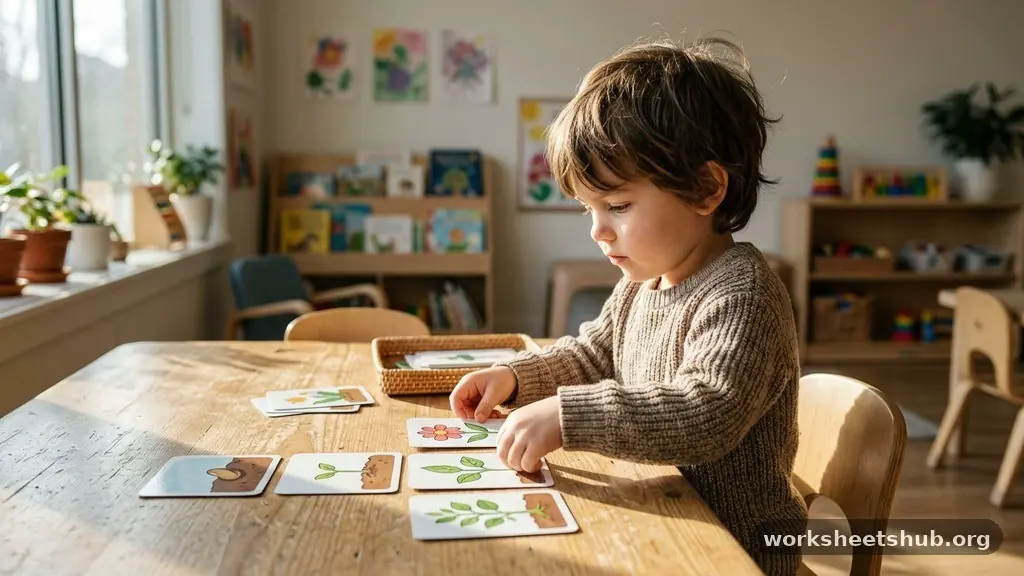
Learning how sequencing exercises help children organize their thinking provides a foundational toolkit for navigating the complexities of daily life. By breaking down tasks into manageable, chronological steps, children gain the ability to process information more efficiently and reduce the overwhelm associated with multi-step instructions.
This practice is not just about ordering events; it is a vital component of cognitive development that bridges the gap between scattered ideas and coherent action. Parents and educators who prioritize these activities see significant improvements in a child’s ability to plan, predict, and execute tasks with greater independence and confidence.
The Role of Temporal Awareness in Cognitive Growth
Temporal awareness is the internal sense of time that allows a child to understand that events happen in a specific order. Without this grasp of duration and sequence, a child might struggle to understand why they must put on socks before shoes.
Sequencing exercises act as a training ground for this mental skill, helping children visualize time as a linear progression. When a child learns to identify the beginning, middle, and end of a story, they are simultaneously building the framework for understanding time.
This development is deeply tied to executive function, the set of mental processes that enable us to plan, focus attention, and manage multiple tasks. By consistently practicing the arrangement of events, children strengthen their working memory.
They learn to hold the “first” step in their mind while preparing for the “second” step. This mental rehearsal is essential for transitioning from impulsive reactions to thoughtful, goal-oriented behavior.
As children mature, this awareness evolves into the ability to estimate how long a task will take. This is a critical milestone for school-aged kids who must manage homework loads and classroom routines.
Teachers often find that students who have practiced sequencing are better at predicting how much time they need for a project. They aren’t just doing tasks; they are developing a internal clock that keeps them on track throughout the day.
Connecting Narrative Structure to Logical Thinking
Narrative structure is one of the most natural ways to introduce the concept of order. Children are wired to respond to stories, and by analyzing a plot, they learn to identify cause and effect.
When a child understands that a character must first find a key before they can open the door, they are practicing logical progression. This isn’t just about reading; it is about recognizing the internal logic that governs the world around them.
Parents can leverage this by asking simple, open-ended questions during bedtime stories. Instead of just reading, ask, “What do you think happened right after the hero climbed the mountain?”
This forces the child to synthesize the information and place it in the correct order. It transforms passive listening into an active exercise in mental organization.
This skill translates directly into better communication. Children who understand narrative structure can better explain their own experiences to adults.
They learn to start at the beginning of their day rather than jumping to the end. This clarity makes it easier for caregivers to understand their needs and for the child to feel heard.
Building Executive Function Through Task Analysis
Task analysis is the process of breaking down a large goal into smaller, actionable steps. For a child, a instruction like “clean your room” can be paralyzing because it lacks a clear starting point.
By using sequencing exercises to identify the individual parts of that task, we provide a roadmap for success. We teach them that the “room” is actually a collection of smaller jobs: picking up toys, making the bed, and putting clothes in the hamper.
This method reduces the cognitive load on the child. When they know exactly what the first step is, they are far more likely to begin the work without hesitation.
It also creates a sense of accomplishment at every stage of the process. Each completed step acts as a positive reinforcement that encourages them to move to the next.
For more information on the development of these skills, the Center on the Developing Child at Harvard University provides extensive resources on how executive function supports learning. Their research highlights how early interventions in task management create long-term benefits for academic performance. By applying these principles at home, you are setting the stage for a more organized and capable student.
Visual Scheduling and Classroom Routine
Visual scheduling is a powerful tool for helping children manage their daily lives. By using pictures or written lists to represent the sequence of a school day, educators provide a constant reminder of what comes next.
This visual aid reduces anxiety because the child always knows what to expect. It eliminates the “what do I do now?” confusion that often leads to disruptive behavior.
In the classroom, a consistent routine acts as a scaffold for the child’s brain. When they know that reading time is always followed by math, they begin to mentally prepare for the shift in subject matter.
This predictability is essential for children who struggle with transitions. The visual schedule serves as an externalized version of their own internal sequencing processes.
These schedules are particularly effective for children who may have challenges with executive dysfunction. By offloading the memory of the sequence to a chart on the wall, the child can focus their energy on the task itself.
It is a simple modification that yields massive results in classroom engagement. Over time, the child internalizes these routines and relies less on the visual prompt.
The Impact of Cause and Effect on Problem-Solving
Understanding cause and effect is the foundation of scientific thinking and advanced problem-solving skills. Sequencing exercises that focus on “if this, then that” scenarios teach children to anticipate consequences.
When a child learns that pouring water into a sandcastle without a bucket will cause it to collapse, they are learning about the physical laws of their environment. This is a form of scientific inquiry that starts in the sandbox.
You can encourage this by using simple sequencing games. Present the child with pictures of a sequence, such as an ice cream cone melting, and ask them to describe why it happened.
This encourages them to look for the catalyst in every situation. They learn that every action has a specific result that follows it in time.
This awareness helps children develop patience and foresight. They begin to understand that they cannot have the reward—the final step—without completing the necessary preparation.
It shifts their perspective from immediate gratification to a process-oriented mindset. This is a hallmark of emotional maturity and logical reasoning.
Pre-Literacy Skills and Sequencing
Sequencing is a core component of pre-literacy skills, particularly when it comes to understanding the structure of language. Reading requires a child to process letters and words in a specific, left-to-right sequence.
If a child cannot follow a simple three-step instruction, they will inevitably struggle with the decoding process required for reading. Sequencing exercises act as a prerequisite for these more complex cognitive tasks.
Activities like sorting objects by size or color are early forms of sequencing that prepare the brain for classification. When a child sorts a bin of blocks, they are identifying patterns and establishing a rule-based order.
This ability to spot patterns is exactly what they will need when they start to recognize phonemes and syllables. It is all part of the same developmental trajectory.
Teachers often use sequencing cards to help students retell stories in the correct chronological order. This practice ensures that the student understands the flow of information before they are asked to write their own stories.
By mastering the sequence, the child feels more confident in their ability to express ideas. It turns the daunting task of writing into a manageable assembly of parts.
Comparing Traditional and Modern Sequencing Tools
Different tools offer various benefits depending on the age and learning style of the child. While traditional flashcards are excellent for individual focus, digital apps provide an interactive environment that can be highly engaging. The following table compares common methods used to improve organizational skills.
| Method | Primary Benefit | Ideal Age Range |
|---|---|---|
| Physical Picture Cards | Tactile engagement and manual sorting | 3–6 years |
| Digital Sequencing Apps | Instant feedback and gamification | 5–9 years |
| Visual Routine Charts | Reduces anxiety during transitions | 4–10 years |
| Storytelling Prompts | Develops narrative logic and vocabulary | 6–12 years |
Each method targets a slightly different aspect of cognitive organization. Using a variety of these tools ensures that the child remains interested and challenged.
It is important to match the complexity of the activity to the child’s current level of metacognition. As they grow more comfortable with simple sequences, you can introduce more abstract or longer-term planning tasks.
Common Questions About Developmental Sequencing
How can I tell if my child is struggling with sequencing?
If your child frequently loses their place in multi-step tasks, struggles to retell a simple event in order, or becomes easily overwhelmed when given more than one direction, they may need more practice with sequencing. Look for patterns where they miss the middle steps of a routine despite knowing the beginning and the end.
At what age should I start these exercises?
You can introduce basic sequencing concepts as early as two or three years old. Simple actions like “first we put on our socks, then our shoes” are the starting point. Keep these activities play-based and short to maintain their interest and prevent frustration.
Can sequencing exercises help with ADHD?
Yes, these exercises are often recommended for children with attention challenges because they provide external structure. By breaking tasks into concrete steps, you help the child focus on one thing at a time. This reduces the sense of being overwhelmed and improves their ability to complete tasks independently.
What is the best way to practice at home?
Integrate sequencing into your daily routine rather than treating it like a chore. Use “first, next, last” language throughout the day, such as when cooking or getting ready for bed. Games that involve sorting or following recipes are also excellent, practical ways to build these skills.
Do sequencing skills improve academic grades?
Yes, there is a strong correlation between organizational skills and academic performance. Students who can logically arrange their thoughts and tasks are better at taking notes, planning essays, and managing study time. These skills are essential for the higher-level thinking required in middle and high school.
Conclusion
Developing the ability to order thoughts and actions is a lifelong asset that begins with simple, intentional practice. By consistently using the methods outlined above, you are providing your child with the mental tools needed to succeed in an increasingly complex world. When you prioritize how sequencing exercises help children organize their thinking, you are not just teaching them to follow directions; you are helping them build the internal architecture for problem-solving and independence.
Start small by incorporating these concepts into your daily routines today. Whether it is through storytelling, visual schedules, or simple household tasks, the focus should remain on making the process of organizing ideas feel natural and rewarding.
As these skills become second nature, you will notice your child approaching challenges with a new level of clarity and confidence. Encourage them to take ownership of their own sequences, and watch as they gain the power to turn their ideas into reality.