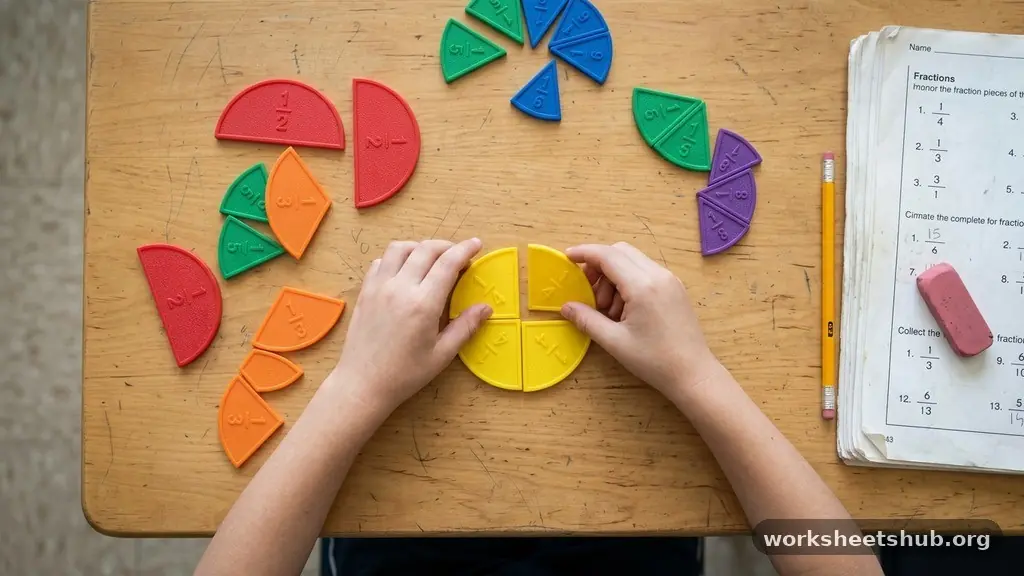
Finding effective beginner-friendly fractions activities for elementary students is a priority for many educators and parents looking to demystify mathematics. When children first encounter parts of a whole, the abstract nature of symbols can feel overwhelming. By focusing on tangible tools and relatable scenarios, you can transform these concepts into something exciting and intuitive.
This article examines practical strategies for teaching fractions through play, visual representation, and consistent repetition. Whether you are in a classroom or at the kitchen table, these methods will help students build a solid foundation that lasts well beyond their primary years.
The Core Concept: Understanding Parts of a Whole
The most fundamental way to introduce fractions is by focusing on the relationship between the numerator and the denominator. Many children struggle because they view these numbers as two separate entities rather than a single value.
Start by explaining that the denominator represents the total number of equal parts, while the numerator shows how many of those parts we have. This distinction is vital for long-term success.
Use everyday objects to solidify this concept before moving to paper-based tasks. Slicing an apple into four equal segments allows a child to hold one-fourth in their hand, making the unit fraction concrete.
When they see that three out of four segments make three-fourths, the abstract math suddenly has a physical identity. This sensory experience is the bedrock of all subsequent learning in the subject.
Utilizing Manipulatives for Tactile Learning
Hands-on learning is non-negotiable when teaching elementary students because it bridges the gap between physical reality and symbolic representation. Manipulatives like fraction circles or plastic tiles allow students to physically move pieces around to see how they fit into a whole.
When a student places two one-fourth tiles over a one-half tile, they witness the relationship firsthand. This visual confirmation is far more powerful than any worksheet.
Math centers are an excellent environment for these activities. By setting up stations with different types of manipulatives, you encourage students to experiment at their own pace.
Some children might prefer fraction strips, while others engage better with circular models that resemble pizzas or pies. Providing variety ensures that every student finds a tool that resonates with their specific learning style.
Visual Models and the Power of Drawing
Visual models serve as a vital bridge between physical objects and abstract equations. Encouraging students to draw their own representations helps them internalize the structure of a fraction.
When a child draws a rectangle and divides it into five equal sections, they are actively constructing their own understanding of the denominator. This process forces them to focus on the necessity of equal-sized parts.
Number lines are another essential tool that should not be overlooked. While circles are great for parts of a whole, number lines help students understand fractions as numbers that exist between integers.
Plotting one-half or three-fourths on a line helps children see that these values have a specific location on the scale. This prepares them for more complex concepts like comparing fractions later in their education.
Common Core Math Standards and Progression
The Common Core Math Standards provide a structured roadmap for introducing these concepts. These guidelines emphasize starting with unit fractions before moving toward more complex operations.
By following a logical progression, you ensure that students aren’t pushed to perform calculations before they truly understand the underlying values. This prevents the frustration that often leads to math anxiety.
Elementary curriculum typically introduces fractions in the second or third grade. Focus initially on recognizing shapes divided into equal parts, then progress to identifying unit fractions.
Only after these basics are firm should you move toward adding fractions with like denominators. Respecting this developmental sequence is the most effective way to ensure long-term mastery.
Comparing Fractions Through Play
Comparing fractions is often where students hit a wall, especially when they assume that a larger denominator always means a larger value. Use visual models to debunk this common misconception immediately.
If you show a child that one-fourth of a cake is smaller than one-half of the same cake, the visual evidence is undeniable. The denominator is a measure of how many slices the whole is cut into, not the size of the slices themselves.
Games like “Fraction War” can make this practice engaging rather than tedious. Each player flips a card with a fraction, and the person with the larger value wins the round.
Using cards that also show a visual model helps students verify their answers quickly. This competitive element keeps energy high and turns a difficult abstract task into a social, fun interaction.
Equivalent Fractions and Pattern Recognition
Once students are comfortable with basic parts, introducing equivalent fractions becomes a natural next step. Use fraction strips to show how two-fourths covers the exact same area as one-half.
Seeing these strips side-by-side allows students to discover the pattern themselves rather than just memorizing a rule. This “aha” moment is crucial for building mathematical confidence.
Encouraging students to write their own equivalent fractions helps solidify the concept. Ask them to find as many fractions as they can that equal one-half.
They will quickly realize that the numerator must be exactly half of the denominator. This simple pattern recognition exercise is a great way to introduce the logic behind simplifying fractions later on.
Handling Improper Fractions and Mixed Numbers
Improper fractions and mixed numbers often intimidate beginners, but they are easy to explain with the right visual aids. Use multiple fraction circles to show that five-fourths is simply one whole and one-fourth.
When a child sees the physical components, the idea of a numerator being larger than a denominator loses its mystery. It is just a way of describing more than one whole.
| Fraction Type | Description | Example |
|---|---|---|
| Unit Fraction | Numerator is 1 | 1/4 |
| Proper Fraction | Numerator smaller than denominator | 3/4 |
| Improper Fraction | Numerator larger than denominator | 5/4 |
| Mixed Number | Whole number plus a fraction | 1 1/4 |
Practice these concepts by using real-world scenarios like measuring ingredients for a recipe. If a recipe calls for one and a half cups of flour, you are already working with mixed numbers.
Showing how to measure this out using a half-cup tool makes the math feel relevant and useful. This context is essential for students who struggle to see why they need to learn these skills.
Frequently Asked Questions
At what age should children start learning about fractions?
Most curriculums introduce the basic concept of equal parts in the second grade. By the third grade, students are usually ready to start formal work with unit fractions and identifying them on number lines.
Why do students struggle so much with denominators?
Students often apply whole-number logic to fractions, thinking that a larger number must mean a larger value. Using visual models and manipulatives is the best way to correct this common misunderstanding.
What are the best tools for teaching fractions at home?
Fraction circles, magnetic tiles, and even simple household items like paper plates or LEGO bricks work wonders. Any activity that allows a child to physically manipulate parts to form a whole is highly effective.
How can I tell if my child is ready to move on to harder concepts?
If they can consistently identify fractions from visual models and order them correctly on a number line, they are likely ready. Don’t rush the process if they still rely heavily on physical manipulatives.
Are worksheets helpful for learning fractions?
Worksheets are useful for practice after a concept has been introduced through hands-on activities. They should never be the primary way to teach the initial concept, as they lack the tactile feedback children need.
Encouraging Mathematical Confidence
Mastering these concepts is a journey that requires patience and consistent, low-stress practice. By prioritizing beginner-friendly fractions activities for elementary students, you create an environment where mistakes are viewed as learning opportunities rather than failures. When children feel safe to experiment with manipulatives, they develop the curiosity needed to tackle more advanced math topics in the future.
Keep your lessons short, focused, and tied to the real world whenever possible. Whether you are using building blocks, kitchen measuring cups, or simple drawings, your goal is to make the numbers feel meaningful.
Continue to celebrate their progress as they grasp each new layer of understanding. With your support and these practical tools, every student can find success in their mathematical development.