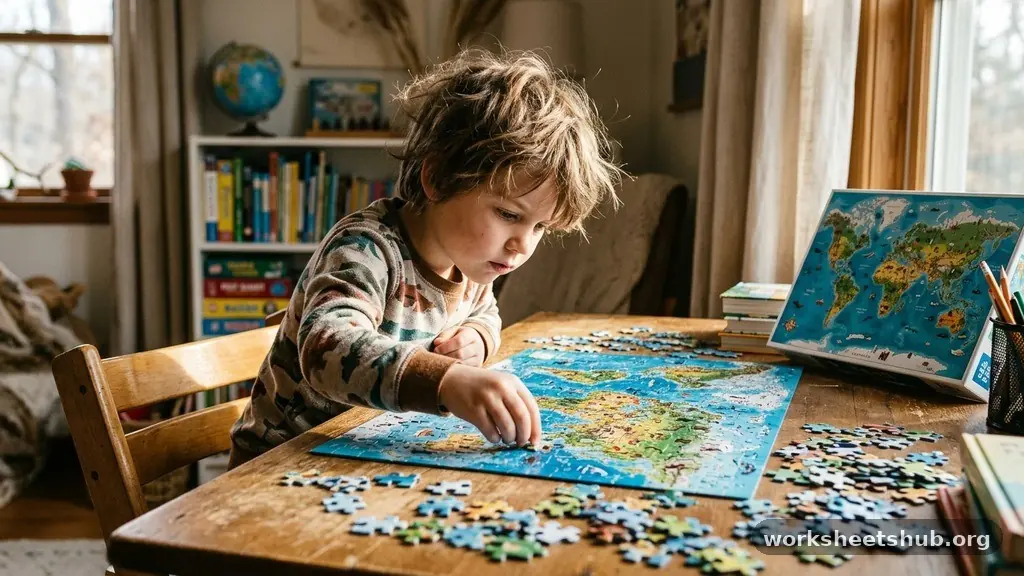
Discovering how visual puzzles can improve children’s problem-solving skills offers parents and educators a simple, effective way to boost early cognitive growth. By engaging with shapes, patterns, and spatial challenges, young minds learn to break down complex tasks into manageable steps. These activities are more than just play; they are foundational exercises that sharpen focus and encourage persistence.
Whether through tactile wooden blocks or digital logic games, the act of solving a visual challenge triggers active learning. You’ll gain a deeper understanding of how these puzzles strengthen neural pathways, turning everyday playtime into a valuable tool for developing essential life skills that children will rely on throughout their academic and personal journeys.
The Direct Connection to Cognitive Development
The primary reason visual puzzles are so effective is their direct impact on spatial reasoning. When a child attempts to fit a piece into a jigsaw puzzle, they are performing a complex mental operation.
They must scan the available pieces, identify potential candidates, and physically manipulate them to see if they fit. This process requires them to hold a mental image of the completed picture while simultaneously analyzing the individual components.
This interaction is a workout for the brain’s executive function. Children must plan their next move, monitor their progress, and adjust their strategy when a piece doesn’t fit as expected.
By repeatedly engaging in this loop, they build the cognitive stamina required for more abstract tasks later in school. Research into early childhood development consistently highlights that these spatial activities are precursors to strong performance in mathematics and engineering.
Developing Pattern Recognition and Logical Deduction
Pattern recognition is the bedrock of logical deduction. When a child works on a geometric puzzle or sorts tiles by color and shape, they are learning to categorize the world.
They begin to notice repetitions, sequences, and relationships between objects that aren’t immediately obvious to the untrained eye. This ability to identify a rule—such as “all edges go on the outside”—is a form of early scientific reasoning.
Once a child identifies a pattern, they use logical deduction to predict the outcome of a specific action. If they notice that two triangles form a square, they don’t have to guess the next time they see a gap in a tangram puzzle.
They apply the rule they learned previously, reducing the time and effort needed to solve the problem. This transition from trial-and-error to rule-based thinking is a significant leap in a child’s mental maturity.
Enhancing Working Memory through Visual Challenges
Working memory is the brain’s “scratchpad” for temporary information. Visual puzzles force children to keep multiple pieces of information active at once.
For example, when completing a complex scene, a child must remember where they saw a specific color or texture that might fit a different area of the board. This constant retrieval and storage of visual data strengthens the capacity of their working memory.
Improving this capacity allows children to follow multi-step instructions more effectively in classroom settings. It also helps them manage larger amounts of information when reading or solving word problems. By training the brain to hold and manipulate more visual elements, parents provide their children with a mental advantage that pays dividends across all subjects.
The Role of Mental Rotation in Spatial Ability
Mental rotation is the ability to imagine how an object would look if it were turned or flipped. This is a critical skill for understanding geometry and physics.
When a child picks up a puzzle piece and rotates it in their hand to align it with a slot, they are practicing this exact cognitive maneuver. They aren’t just looking at the object; they are simulating its movement in their mind.
This skill is highly predictive of future success in STEM fields. Children who excel at mental rotation tasks are better at understanding blueprints, maps, and even the mechanics of how objects fit together. Providing puzzles that require frequent rotation, such as 3D block puzzles or complex pattern blocks, gives them a safe environment to master this sophisticated spatial manipulation.
Comparing Different Types of Visual Puzzles
Not all puzzles engage the brain in the same way. Different formats target specific skills, from fine motor control to abstract logic. The following table illustrates how various puzzle types contribute to different developmental areas.
| Puzzle Type | Primary Skill | Secondary Benefit |
|---|---|---|
| Jigsaw Puzzles | Pattern Recognition | Patience and Focus |
| Tangrams | Geometric Relationships | Mental Rotation |
| Logic Grids | Logical Deduction | Working Memory |
| Building Blocks | Spatial Reasoning | Engineering Concepts |
Neuroplasticity and the Learning Process
The brain’s ability to reorganize itself by forming new neural connections is known as neuroplasticity. When a child encounters a new, challenging puzzle, their brain is literally building new pathways to accommodate the difficulty. This is why it’s important to provide puzzles that are “just right”—challenging enough to require effort, but not so hard that they cause frustration.
When a child solves a difficult puzzle, the brain rewards them with a sense of accomplishment. This reinforcement loop encourages them to seek out new challenges, creating a positive cycle of growth.
Over time, these repeated mental efforts make complex problem-solving feel more natural and less daunting. The brain becomes more efficient at processing visual information and applying logic to new situations.
Common Questions About Visual Puzzles
At what age should children start using visual puzzles?
Children can begin with simple, oversized wooden knobs or foam puzzles as early as 12 to 18 months. These early interactions help with hand-eye coordination before moving toward more complex logic puzzles around age three or four.
How do I choose the right difficulty level?
Look for puzzles where your child can complete about 75% of the task independently. If they are constantly asking for help, the puzzle is likely too advanced; if they finish it in seconds without looking up, it’s time for a more complex challenge.
Are digital puzzles as effective as physical ones?
Digital puzzles are excellent for convenience and offer immediate feedback, but physical puzzles provide vital tactile sensory input. A mix of both is ideal, as physical objects help children understand scale and depth in the real world.
How can I encourage my child when they get frustrated?
Focus on the process rather than the final result. Ask open-ended questions like “What do you think would happen if we turned this piece?” or “Have you seen a shape like this before?” to guide them toward their own solution.
Do these skills transfer to school work?
Yes, the ability to break down a large problem into smaller parts is directly transferable. Whether it’s organizing a writing assignment or solving a math equation, the strategies learned through puzzles become part of a child’s toolkit.
Strategic Benefits for Lifelong Learning
* Persistence: Children learn that failure is just a step toward the correct solution.
* Focus: Extended periods of puzzle-solving train the brain to ignore distractions.
* Vocabulary: Describing shapes, corners, and colors builds descriptive language skills.
* Confidence: Successfully completing a difficult task builds a strong sense of self-efficacy.
* Planning: Learning to sort pieces before starting demonstrates the value of preparation.
Building a Foundation for Future Success
Incorporating these activities into a daily routine doesn’t require expensive kits or high-tech equipment. A simple set of geometric shapes or a cardboard puzzle can provide hours of productive mental training. By observing their progress, you can witness firsthand how visual puzzles can improve children’s problem-solving skills over time.
Start by setting aside a dedicated space where your child can leave a puzzle in progress without it being disturbed. This allows them to return to the challenge whenever they feel ready, reinforcing the habit of deep, sustained concentration.
As they grow, rotate the types of puzzles they use to keep their brain engaged and challenged. With consistent encouragement and a variety of materials, you are helping your child build a sharper, more resilient mind that will serve them well for years to come.