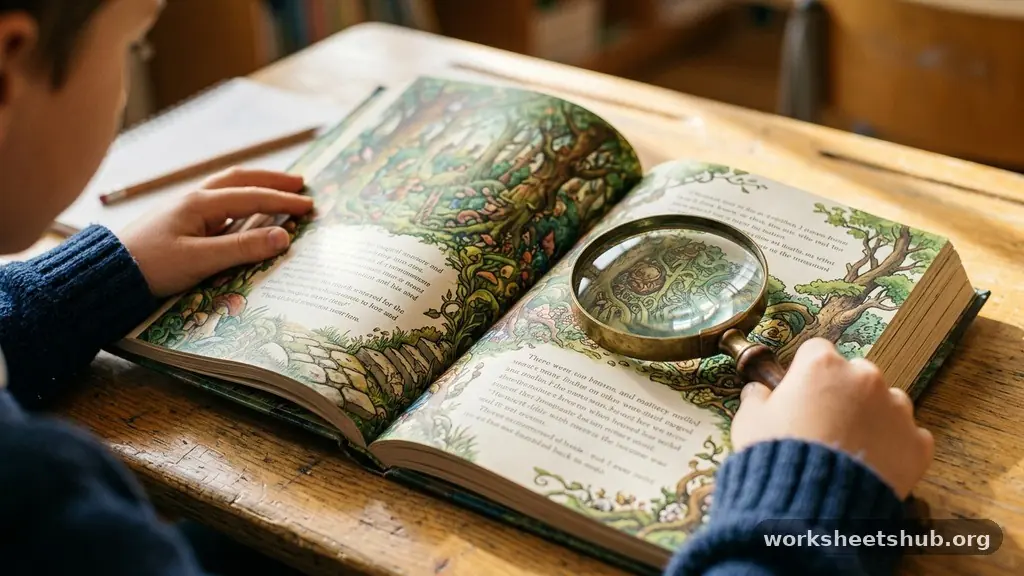
Understanding how picture-based questions can strengthen reading comprehension begins with recognizing that our brains process visual information significantly faster than text. By integrating imagery into the literacy process, educators and parents provide a necessary bridge for learners who struggle to decode complex sentences.
This approach transforms a passive reading experience into an active, analytical engagement with the material. You will discover how specific techniques leverage visual input to improve retention and critical thinking, ultimately making the act of reading more accessible and enjoyable for students of all levels.
The Cognitive Foundation of Visual Literacy
Visual literacy serves as the primary gateway for students to decode the world around them before they even encounter a written word. When we ask a reader to examine an image, we are training them to observe details, identify patterns, and synthesize information.
This foundational skill is essential because reading is not merely the mechanical act of pronouncing words; it is the cognitive process of constructing meaning from symbols. By starting with images, learners build the confidence to apply the same observational rigour to printed text.
When students look at a picture, they are performing a form of pre-reading that relies on existing schema. They bring their own experiences to the image, allowing them to make predictions about what the accompanying text might reveal.
This process reduces the intimidation factor often associated with dense, academic paragraphs. By anchoring the learning in the visual, you provide a stable starting point that helps the brain organize new information more efficiently.
Using Images to Boost Inference Skills
Inference is the ability to read between the lines, a skill that many students find challenging when faced with only text. Picture-based questions force the reader to look for clues that are not explicitly stated, such as a character’s body language or the setting of a scene.
This practice directly mirrors the cognitive requirements of inferring meaning in a story. If a student can identify that a person in a picture looks worried because of their furrowed brow, they are better prepared to recognize a character’s anxiety in a novel.
These exercises move students beyond literal recall and into the realm of higher-order thinking. When you ask, “What do you think happened just before this picture was taken?” you are prompting the reader to construct a narrative.
This is exactly how we want students to approach literature. By repeatedly practicing this on images, the habit of searching for implied meaning becomes second nature, leading to significant gains in overall comprehension.
Pedagogical Scaffolding for Emergent Readers
Pedagogical scaffolding is the temporary support provided to help learners reach a higher level of understanding. For emergent readers, images function as the ultimate scaffold.
When a child sees a picture of a dog chasing a ball, the image provides the context needed to decode the sentence “The dog ran after the ball.” Without the image, the cognitive load is entirely focused on word recognition; with the image, the focus shifts to meaning-making.
This method is particularly effective for students learning a second language or those with learning disabilities. By providing a visual anchor, you ensure that the student is not lost in a sea of abstract vocabulary.
You can gradually remove these visual aids as the student’s fluency increases, which is the hallmark of effective scaffolding. This transition ensures that the learner develops independence without being overwhelmed by the complexity of the text.
Connecting Images to Bloom’s Taxonomy
Bloom’s Taxonomy provides a hierarchical framework for learning objectives, and images are excellent tools for climbing this ladder. At the base level of ‘Remembering’, you might ask a student to identify objects in a picture.
As you move toward ‘Analyzing’ or ‘Evaluating’, the questions become more sophisticated. You might ask why the illustrator chose a specific color palette or how the composition of the image conveys a particular mood.
This approach ensures that students are not just surface-level readers. By using images to hit every level of Bloom’s Taxonomy, you prepare students for the rigorous demands of standardized testing and academic writing.
It turns the reading session into a laboratory for critical thinking where every image is a data point to be examined. This structured approach helps ensure that comprehension is deep, nuanced, and transferable.
The Role of Graphic Organizers
Graphic organizers act as a physical map for a student’s thinking process. When combined with images, they become even more powerful tools for organizing complex ideas.
For instance, a Venn diagram can be used to compare a real-life photograph with a fictional illustration of the same topic. This encourages students to categorize their thoughts visually before attempting to write them down in paragraphs.
The visual nature of these organizers helps students who are naturally spatial learners. It allows them to see the relationship between different concepts, such as cause and effect or sequence, without getting bogged down by sentence structure.
By mapping out ideas visually, students often find that writing becomes much easier because the heavy lifting of organization has already been done. You can find more information on these strategies through the Reading Rockets resource center, which provides extensive data on literacy interventions.
Comparing Traditional vs. Visual-Based Instruction
The efficacy of using imagery can be seen when comparing traditional text-heavy instruction with multimodal approaches. Traditional methods rely heavily on auditory and linguistic processing, which can leave behind students who learn best through visual pathways. A balanced approach that incorporates both ensures that all learners can access the curriculum.
| Instructional Method | Primary Cognitive Load | Best Suited For |
|---|---|---|
| Traditional Text-Only | Linguistic Decoding | Advanced Readers |
| Picture-Based Inquiry | Visual Synthesis | Emergent & Reluctant Readers |
| Multimodal Integration | Balanced Dual-Coding | Diverse Classrooms |
As the table shows, the integration of images into the classroom is not just a supplement—it is a core instructional strategy. By shifting the balance, educators can create a more inclusive environment that supports various learning styles. This is particularly vital in subjects like history or science, where visual data is just as important as the written report.
Managing Cognitive Load Theory
Cognitive load theory posits that our working memory has a limited capacity for processing information at one time. When a text is too difficult, the brain becomes overwhelmed, and comprehension shuts down.
Picture-based questions serve to manage this load by providing “dual-coding.” This means the brain stores information in two ways: as verbal information and as visual imagery.
When you present a student with a picture and a question, you are effectively using their visual memory to support their verbal processing. This prevents the brain from hitting a wall of frustration.
Instead of trying to hold onto abstract words alone, the student uses the image as a memory hook. This makes the information “stickier,” leading to better long-term retention of the material being studied.
Practical Strategies for the Classroom and Home
To effectively use picture-based questions, you should focus on open-ended inquiry rather than simple yes-or-no prompts. Instead of asking, “Is the boy happy?” try asking, “What clues in the boy’s face and posture suggest how he is feeling?”
This subtle shift forces the student to justify their answer using evidence from the image. It is a direct application of the techniques used in literary analysis.
- Start with high-quality, detailed photography to encourage observation.
- Use wordless picture books to focus entirely on narrative construction.
- Encourage students to create their own illustrations to demonstrate their understanding of a text.
- Model the process of “reading” an image by thinking aloud in front of the student.
- Vary the types of images, including maps, charts, and historical documents.
These simple adjustments can change the entire tone of a reading session. It transforms the experience from a chore into a detective game. By consistently applying these methods, you will notice that students become more observant, more curious, and much more capable of unpacking the meaning behind any text they encounter.
Frequently Asked Questions
Can picture-based questions be used for older students?
Absolutely. While often associated with early childhood education, analytical visual questioning is essential for older students analyzing complex literature, primary historical sources, or scientific diagrams. It forces them to engage with the text at a deeper, more critical level.
Do these techniques distract from actual reading?
On the contrary, they enhance reading by preparing the brain to process information more efficiently. When used as a scaffold, images help students build the necessary confidence to tackle more difficult passages without feeling defeated by complex vocabulary.
How do I choose the right images for comprehension?
Select images that are relevant to the text’s theme but offer enough detail to allow for multiple interpretations. High-resolution photographs, historical paintings, or even editorial cartoons are excellent choices because they contain layers of meaning that invite discussion.
Are there specific subjects where this works best?
While effective everywhere, this approach is particularly transformative in history, social studies, and science. These subjects rely heavily on visual evidence, and teaching students how to interpret that evidence is a critical part of their academic development.
How long should a typical image-based session last?
Keep these sessions focused and relatively brief, usually 10 to 15 minutes. The goal is to provide a quick burst of analytical practice that can be immediately applied to the main reading task, rather than letting the exercise become a separate, disconnected project.
Conclusion
Integrating visual elements into your literacy routine is a proven way to help students unlock deeper levels of understanding. By mastering how picture-based questions can strengthen reading comprehension, you provide learners with the tools they need to decode both the printed page and the world around them. This dual approach to learning reinforces memory, builds critical thinking, and keeps the spark of curiosity alive in the classroom.
Start by selecting a single image for your next lesson and asking one open-ended question to see the immediate impact on engagement. Watching a student transition from passive decoding to active analysis is a rewarding experience, and it all begins with a simple, well-placed visual prompt.