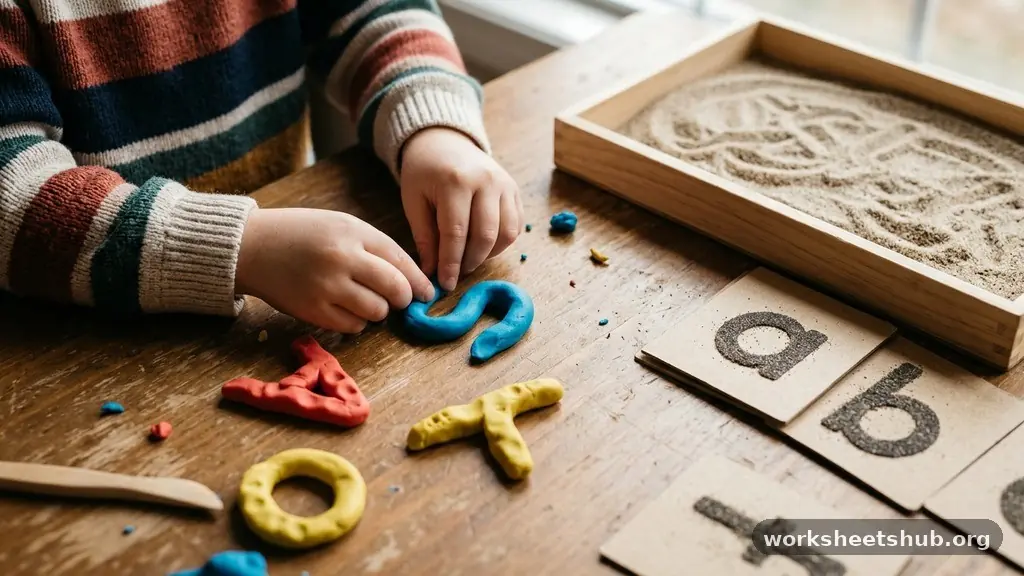
Engaging children in literacy through creative alphabet activities beyond traditional letter practice transforms static pencil-and-paper tasks into dynamic, memorable experiences. By integrating movement, sensory exploration, and play, you can significantly improve a child’s retention of letter shapes and sounds while fostering a genuine love for language. This approach moves past repetitive worksheets to address the diverse ways young minds absorb foundational literacy skills.
If you are seeking ways to deepen early childhood literacy, these strategies offer a bridge between abstract symbols and tangible understanding. You will gain a toolkit of practical, evidence-based methods to support development through active exploration and meaningful discovery in your home or classroom.
The Science of Multisensory Learning
Traditional rote memorization often fails because it ignores the brain’s preference for multisensory input. When a child learns to read, they must bridge the gap between abstract visual symbols, known as graphemes, and the specific auditory signals they represent. Multisensory learning creates multiple neural pathways for a single piece of information.
By involving touch, sight, and sound simultaneously, you ensure that the brain has more than one way to retrieve the data later. This is particularly crucial for building strong phonemic awareness in the early years.
Kinesthetic letter formation serves as a cornerstone of this pedagogical approach. Instead of merely looking at a letter, the child uses their body or hands to reproduce the shape. This physical engagement anchors the abstract concept of a letter to a concrete movement.
Research into phonemic awareness and phonics suggests that children who actively manipulate their learning environment demonstrate faster progress in decoding. When a child traces a letter in the air or uses their whole body to mimic its curves, they are engaging their vestibular and proprioceptive systems. This is far more effective than passive observation.
Tactile Tracing and Sensory Play
Tactile tracing provides the immediate feedback loop necessary for refining fine motor skills while reinforcing letter recognition. Using textured surfaces allows children to feel the topography of each letter. For instance, using sandpaper letters or raised-line cards provides a physical boundary that guides the child’s finger.
This tactile feedback informs the brain about the specific start points, curves, and angles of every character. It turns writing into a sensory-rich experience rather than a purely visual one.
Sensory bins offer another layer of engagement for developing literacy. By hiding plastic letters in a bin filled with dried rice, beans, or kinetic sand, you turn letter identification into a treasure hunt. Children must dig, search, and identify letters by touch before they even see them.
This game-like structure eliminates the anxiety often associated with “correct” writing. It allows for repeated exposure in a low-pressure environment, which is vital for building confidence.
Kinesthetic Movement Activities
Children often learn best when they can move their entire bodies. Incorporating physical activity into your alphabet lessons helps anchor learning through muscle memory. You can use masking tape to create large letters on the floor.
Ask the child to walk, crawl, or hop along the lines of the letter. This helps them internalize the stroke sequence required for writing.
Physical movement also supports the development of letter sounds. You might assign a specific movement to each letter of the alphabet. For example, when they see the letter “S,” they might slither like a snake, or for “J,” they might perform a small jump.
This connects the sound to the physical action, reinforcing the letter-sound correspondence. It breaks up the monotony of sedentary learning and keeps the child physically invested in the lesson.
Implementing an Alphabet Scavenger Hunt
An alphabet scavenger hunt is a highly effective way to connect classroom concepts to the real world. By asking a child to find objects that start with a specific sound, you move from theoretical letter recognition to practical application.
This activity forces the child to think about their environment through the lens of phonics. It turns a walk through the house or a trip to the park into a literacy-building exercise.
To make this more challenging, you can group items by their initial phonemes. You might ask them to find three items that start with the “B” sound and put them in a dedicated basket.
This encourages categorization, which is a key cognitive skill related to orthographic mapping. It also reinforces the idea that letters are not just things to be written, but functional tools that label the world around us.
Comparing Traditional vs. Creative Approaches
Understanding the differences between conventional methods and play-based learning helps you balance your daily routine. While traditional methods have their place in structure, they often lack the emotional engagement required for long-term retention. The following table highlights why creative methods often yield better results.
| Feature | Traditional Practice | Creative Alphabet Activities |
|---|---|---|
| Primary Sense | Visual (Sight) | Multisensory (Touch/Sound/Sight) |
| Engagement Level | Low (Passive) | High (Active) |
| Skill Focus | Rote Memorization | Phonemic Awareness/Synthesis |
| Environment | Desk-based | Dynamic/Flexible |
Utilizing Sand Trays for Precision
Sand trays are a classic tool for a reason. They provide a high-friction, tactile surface that is perfect for early writers. When a child draws a letter in the sand, they receive immediate physical resistance.
This resistance forces them to slow down and focus on the precision of the letter shape. It is a forgiving medium, as a quick shake resets the board for another attempt.
You can also use salt or colored sugar in a tray to add a visual element to the tactile experience. Encourage the child to say the letter sound as they trace the shape.
This creates a powerful connection between the sound, the visual representation, and the motor movement. It is an excellent way to prepare hands for pencil control without the frustration of erasing or crossing out mistakes.
Integrating Literacy into Daily Routines
Literacy does not need to be confined to a specific “learning time.” You can integrate creative alphabet activities into everyday tasks to make them feel natural and non-intrusive. For instance, help the child write letters in the condensation on a window after a shower.
Use bath crayons to write letters on the tub walls during bath time. These small, frequent interactions add up to significant learning over time.
You can also incorporate literacy into meal preparation. Ask the child to find ingredients that start with a specific letter. If you are making “T” tacos, talk about the sound of the “T” while you chop tomatoes.
This provides context for the letters and demonstrates their utility. It turns the alphabet into something that is part of their daily life rather than a separate, difficult chore.
Key Strategies for Success
* Focus on the sound of the letter rather than just the name to build phonemic awareness.
* Keep sessions short to match the child’s attention span and prevent burnout.
* Use a variety of textures in your sensory bins, such as dry pasta, pom-poms, or water beads.
* Celebrate the process of discovery rather than focusing solely on the accuracy of the final shape.
* Rotate materials frequently to maintain high levels of curiosity and engagement.
Frequently Asked Questions
How do I know if my child is ready for these activities?
Children typically show interest in letters and sounds between the ages of three and five. If they start asking about signs, labels, or the letters in their name, they are developmentally primed for play-based literacy.
What if my child struggles with fine motor skills?
Focus on large-scale movements first, such as tracing letters in the air or using arm movements on a whiteboard. These gross motor activities build the shoulder and arm strength necessary for later fine motor tasks like holding a pencil.
Are these activities suitable for older children?
Yes, you can adapt these methods for older children by increasing the complexity. Instead of single letters, focus on digraphs, word families, or even short sentences using these multisensory techniques.
How often should we practice these activities?
Consistency is more important than duration. Five to ten minutes of playful, focused engagement every day is significantly more effective than an hour-long, forced session once a week.
Should I prioritize handwriting or letter sounds?
Early childhood literacy research emphasizes phonemic awareness and letter-sound correspondence as the foundation for reading. Prioritize the sound and the recognition of the shape, as the mechanical skill of handwriting will develop in tandem.
Building Lasting Literacy Foundations
Moving beyond traditional worksheets allows you to turn the alphabet into a living, breathing part of a child’s world. By prioritizing multisensory engagement and play-based learning, you create a positive emotional association with reading and writing.
These creative alphabet activities beyond traditional letter practice ensure that children develop the necessary skills while maintaining their natural curiosity. When learning feels like an adventure rather than a chore, the information sticks.
Start by choosing one or two of these strategies to integrate into your week. Observe how your child responds to the shift from passive observation to active participation. You will likely notice an increase in their confidence and a greater willingness to engage with language-based tasks.
Continue to experiment with new textures, movements, and games to keep the process fresh and exciting. Your commitment to these creative methods will provide a strong, lasting foundation for their future academic success.