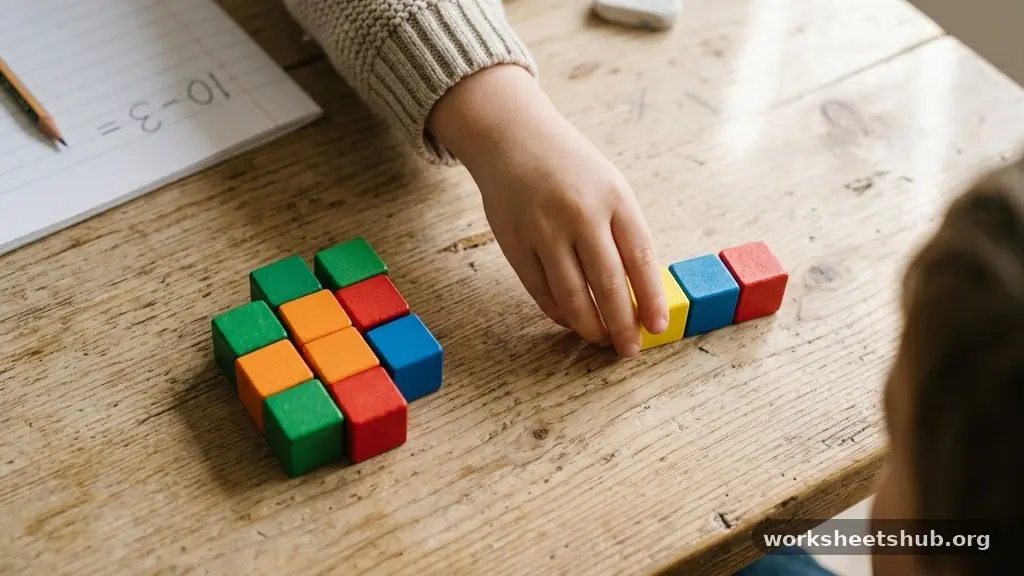
Developing a solid foundation in arithmetic through simple Subtraction Activities for Building Math Confidence helps children move past the fear of making mistakes. When students engage with math through play and physical interaction, they transform abstract symbols into tangible concepts they can truly master. By focusing on the relationship between numbers rather than just memorizing facts, learners develop the internal resilience needed to tackle more complex equations later on.
This approach minimizes math anxiety by shifting the focus from speed to genuine conceptual understanding. In this article, we explore how hands-on strategies and visual tools turn subtraction into an approachable, rewarding skill for every young student.
The Core Mechanics of Subtraction
To understand how to teach subtraction effectively, one must first recognize the fundamental components of the operation. Every subtraction problem consists of three distinct parts: the minuend, the subtrahend, and the difference.
The minuend is the total amount you start with, the subtrahend is the quantity you take away, and the difference is the resulting value. When children learn these terms, they stop viewing subtraction as a mysterious process and start seeing it as a structured relationship between quantities.
Using proper terminology from an early age helps clarify the logic behind the math. If a child knows that the minuend is always the largest number in a basic subtraction problem, they are less likely to reverse the numbers and subtract the larger from the smaller.
This foundational knowledge is a critical step in building math confidence. By removing the guesswork, you provide the student with a reliable framework for solving any problem they encounter.
Using Manipulatives for Physical Learning
Manipulatives serve as the bridge between the physical world and abstract mathematical notation. These objects allow children to see, touch, and move quantities, which solidifies the concept of taking away.
Common household items like buttons, plastic counters, or dried beans work perfectly for this purpose. When a child physically removes three beans from a pile of ten, the “taking away” aspect of subtraction becomes an undeniable reality rather than a vague instruction on a worksheet.
The transition from physical objects to written numbers is known as the concrete-representational-abstract sequence. You should allow children to spend ample time with the concrete phase before rushing them to pencil-and-paper tasks.
If they don’t have a firm grasp of the physical quantity, the symbols on the page will remain meaningless to them. By grounding their practice in physical reality, you ensure they understand the “why” behind the operation.
The Power of Visual Aids
Visual aids such as the number line provide a spatial representation of mathematical progress. A number line helps students visualize the distance between two numbers, which is exactly what a difference represents.
When a child uses a number line to jump backward from the minuend, they are effectively counting backward to find the answer. This activity reinforces the idea that subtraction is simply movement along a path of numbers.
Another highly effective visual tool is the use of number bonds. These diagrams show the relationship between a whole number and its parts, helping students see how numbers decompose.
If a child knows that 8 is made of 5 and 3, they will intuitively understand that 8 minus 5 must equal 3. This conceptual understanding is much more powerful than rote memorization because it allows the child to derive answers for themselves.
Strategies for Building Fluency
Subtraction fluency doesn’t happen overnight, but it can be encouraged through consistent, low-pressure practice. Focusing on small, manageable chunks of information prevents children from feeling overwhelmed.
You can break down the learning process into logical milestones that build upon one another. The following table outlines how different tools assist in various stages of learning:
| Learning Tool | Primary Benefit | Best Used For |
|---|---|---|
| Base-ten blocks | Visualizing regrouping | Multi-digit subtraction |
| Number line | Spatial distance | Basic subtraction facts |
| Number bonds | Part-part-whole relationships | Mental math strategies |
| Counters | Concrete removal | Early introduction |
Once a child masters these tools, they begin to develop their own internal strategies for solving problems. They might start by counting backward from the minuend, or they might look for the difference between the two numbers by counting up from the subtrahend.
Both methods are valid and demonstrate a deepening level of math confidence. Encourage your student to explain their thinking process out loud to you, as this verbalization cements their logic.
Integrating Math Games into Daily Life
Math games turn what could be a chore into an exciting challenge. Games allow for repetition without the monotony of a traditional workbook, which is essential for maintaining engagement.
For instance, a simple card game where players draw two cards and find the difference between them can be played anywhere. The competitive yet friendly nature of these games lowers the stakes, making it easier for children to take risks and learn from their mistakes.
The NRICH project from the University of Cambridge offers a wealth of resources that emphasize problem-solving and mathematical reasoning. Engaging with these types of tasks helps students realize that math is a creative endeavor, not just a set of rigid rules.
When children view subtraction as a puzzle to be solved rather than a test to be passed, their anxiety levels drop significantly. This shift in perspective is perhaps the most important factor in long-term academic success.
Common Hurdles and How to Overcome Them
Many students hit a wall when they encounter regrouping or “borrowing.” This is often because they haven’t fully grasped the base-ten system. Before moving to regrouping, ensure the child understands that ten ones can be exchanged for one ten.
Base-ten blocks are the perfect tool for this, as they provide a physical representation of this exchange. If a child tries to subtract 8 from 12 and doesn’t know how, they can physically trade a ten-stick for ten individual units to complete the task.
Another hurdle is the tendency to rush through problems to avoid the perceived “pain” of the work. If you notice a child is guessing, slow the process down and ask them to show their work with physical objects again.
Encourage them to explain why they chose a specific step. This forces them to slow down and focus on the logic rather than just arriving at an answer.
Developing Mental Math Skills
Mental math is the ultimate goal of building subtraction fluency. Once a child has spent enough time with physical manipulatives and visual aids, they will begin to internalize these patterns. You can foster this by asking “what if” questions during daily routines.
For example, if you are buying fruit, ask them how many items would be left if you took a few away. These real-world applications make the math relevant and memorable.
* Start with numbers within 10 to build initial confidence.
* Introduce the concept of “doubles” and “near-doubles” to simplify calculations.
* Practice counting backward from various starting points to improve fluency.
* Encourage the use of “friendly numbers” to bridge the gap between complex values.
* Celebrate the process of finding the answer rather than just the result itself.
By focusing on these strategies, you help the student develop a mental library of number relationships. This library allows them to solve problems quickly and accurately without needing to rely on external tools forever. It is a gradual process, so be patient and provide plenty of positive reinforcement as they make progress.
Creating a Supportive Learning Environment
Math confidence is as much about emotional support as it is about cognitive ability. Children often internalize the frustration of their parents or teachers, so keeping a calm, encouraging demeanor is vital.
If a child makes a mistake, treat it as a valuable data point that shows exactly where they need more practice. Never frame a wrong answer as a failure, but rather as a step closer to understanding the correct logic.
Consistency is more important than intensity when it comes to learning math. Ten minutes of focused, fun, and interactive practice every day is far superior to an hour of grueling work once a week.
Create a space where math is treated as a natural part of life, like cooking, shopping, or playing games. When you model a positive attitude toward problem-solving, your child will naturally adopt the same mindset.
Frequently Asked Questions
How do I know when my child is ready to move from manipulatives to mental math?
You will notice the child starting to hesitate less and reach for objects less frequently. They might begin to describe how they are calculating in their head, such as “I know that 10 minus 3 is 7, so 11 minus 3 must be 8.” This verbalization is a clear sign that they are developing the necessary mental models.
What if my child gets frustrated during subtraction activities?
Take a break immediately. Frustration is a signal that the task is either too difficult or that the child is fatigued. Switch to a different, lighter activity or return to a concept they have already mastered to rebuild their confidence before trying again.
Are worksheets completely useless for building math confidence?
Worksheets have their place, but they should never be the primary tool for learning. They are useful for practice and assessment after a concept has been introduced and solidified through hands-on activities. Use them sparingly to avoid triggering the anxiety that often comes with repetitive, abstract tasks.
How can I tell if my child has truly mastered a subtraction concept?
True mastery is demonstrated when a child can apply a concept in a new context. If they can solve a word problem or explain the logic behind an equation to someone else, they have moved beyond rote memorization. Mastery also includes the ability to identify when they have made an error and how to correct it.
Building Lasting Mathematical Resilience
Simple Subtraction Activities for Building Math Confidence are not just about getting the right answer; they are about fostering a growth mindset. By using physical tools, visual aids, and interactive games, you provide the structure children need to feel capable and secure. Remember that every child learns at their own pace, and the goal is to build a positive relationship with numbers that will last a lifetime.
As you continue to support their journey, focus on the small wins and the moments of clarity that prove they are making progress. With patience and the right approach, you can transform the way your child experiences arithmetic, setting them up for success in all their future mathematical endeavors.